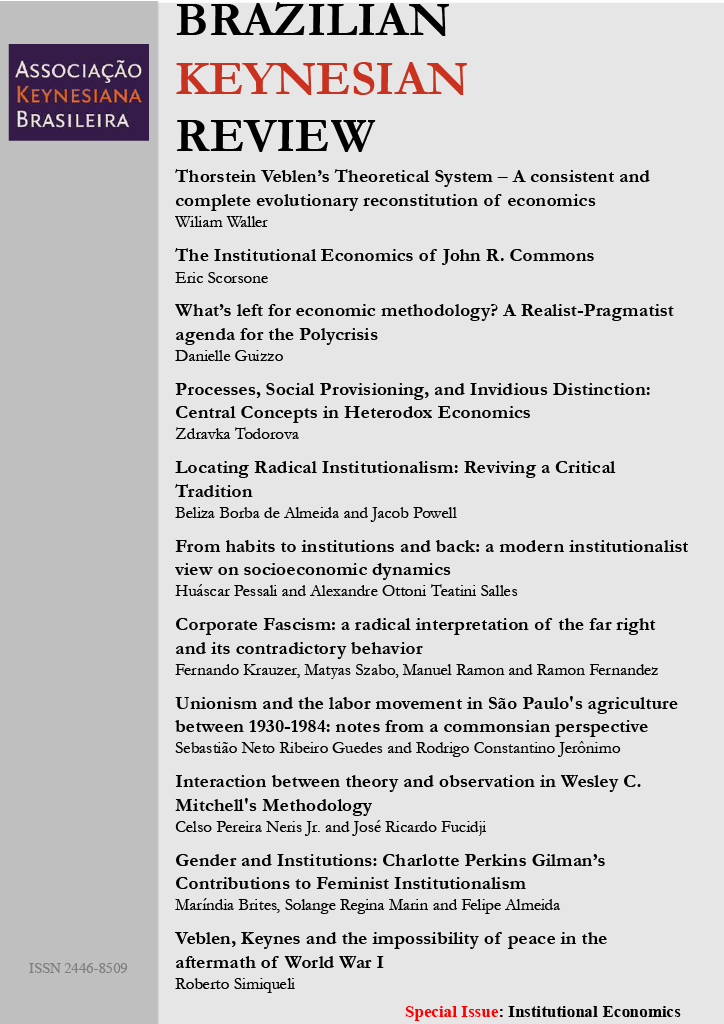
The Institutional Economics of John R. Commons
Keywords:
Institutional Economics, History of Economic ThoughtAbstract
This article is an introduction to the work of John R. Commons’s institutional economics and argues that his work offers a coherent framework for analyzing economic behavior, institutional change, and conflict resolution. Commons’s approach begins with institutions and transactions, emphasizing how working rules structure, constrain, and enable individual action. The article develops his five interrelated principles—scarcity, efficiency, futurity, custom, and sovereignty. There is an examination of three major dimensions of Commons’s thought: his behavioral foundations, his adaptation of Weberian ideal types, and his theory of conflict resolution. Particular attention is given to Commons’s view of individuals as active, socially situated actors whose choices are shaped through negotiation, persuasion, coercion, and collective action. His concept of reasonable value is presented as a pragmatic alternative to both laissez-faire naturalism and utopian institutional design. Rather than seeking a perfect equilibrium, Commons emphasized investigation, comparison of institutional arrangements, and attainable improvements. Commons’s framework remains relevant for twenty-first-century economic analysis because it provides a method for evaluating alternative institutions in terms of practical criteria.
Downloads
References
Broda, Philippe. (2013). Conflict resolution: a key to the interpretation of John R. Commons’s intellectual journey. Journal of Economic Issues, 47 (4): 855–872.
Carlin, Edward A. (1952). John R. Commons-Institutional Theorist. Social Forces, 30(4): 379–387.
Commons, John R. (1893). The distribution of wealth. New York and London: Macmillan.
Commons, John R. (1907). Proportional representation. New York: Macmillan.
Commons, John R. (1925). Law and Economics. The Yale Law Journal, 34(4): 371–382.
Commons, John R. (1927). Religion and the rise of capitalism. American Economic Review, 17(1): 63–68.
Commons, John R. (1934). Institutional Economics: Its Place in Political Economy. Vol. 1. New York: Transaction Publishers.
Commons, John R., & Selig Perlman. (1929). Der Moderne Kapitakismus. American Economic Review, 19(1): 78–88.
Copeland, Morris A. (1936). Commons’s institutionalism in relation to problems of social evolution and economic planning. The Quarterly Journal of Economics, 50(2): 333–346.
Dugger, William M. (1979). The reform method of John R. Commons. Journal of Economic Issues, 13(2): 369–381.
Evans, Christopher H. (2017). The social gospel in American religion: A history. New York: New York University Press.
Gruchy, Allan G. (1940). John R. Commons’ concept of twentieth-century economics. Journal of Political Economy, 48(6): 823–849.
Hamilton, Walton H. (1919). The Institutional Approach to Economic Theory. The American Economic Review, 9(1): 309–318.
Hodgson, Geoffrey M. (2003). John R. Commons and the Foundations of Institutional Economics. Journal of Economic Issues, 37(3): 547–576.
Hohfeld, Wesley Newcomb. (1917). Fundamental legal conceptions as applied in judicial reasoning. The Yale Law Journal, 26(8): 710–770.
Lawson, Clive. (1994). The transformational model of social activity and economic analysis: a reinterpretation of the work of JR Commons. Review of Political Economy, 6(2): 186–204.
Rutherford, Malcolm. (1983). JR Commons’s institutional economics. Journal of Economic Issues, 17(3): 721–744.
Schmid, A. Allan. (1972). Analytical Institutional Economics: Challenging Problems in the Economics of Resources for a New Environment. American Journal of Agricultural Economics, 54(5): 893–901.
Weber, M. (1904 [1949]). The “objectivity” of knowledge in social science and social policy. In E. A. Shils & H. A. Finch (Eds. & Trans.), The methodology of the social sciences (pp. 49–112). Free Press.
Weber, M. (1920 [1978]). Economy and society: An outline of interpretive sociology (G. Roth & C. Wittich, Eds.). University of California Press.
Whalen, Charles J. (1998). Economic Insecurity and the Problem-solving Approach of John R. Commons. In Proceedings of the Annual Meeting–Industrial Relations Research Association (Vol. 1). Industrial Relations Research Association.
Wolfe, Albert B. (1936). Institutional reasonableness and value. The Philosophical Review, 45(2): 192–206.
Downloads
Published
How to Cite
Issue
Section
License
Copyright (c) 2026 Eric Scorsone

This work is licensed under a Creative Commons Attribution 4.0 International License.
- Authors keep copyrights and concede to the Journal the right to the first publication, with the paper simultaneously licenced under the Creative Commons Attribution 4.0 International License which allows recognised author and journal work sharing.
- Authors are authorized to assume additional contracts separately, for non-exclusive versions of the paper published in this journal (e.g.: publish in an instituional repository or as a book chapter) with the recogntion of authorship and initial publication in this journal.
- Authors are allowed (and are estimulated) to publish and distribute their work online (e.g.: in institutional repositories or at their personal websites) at any point before or during the editorial process, once this may generate productive alterations on the paper, as well as increse the factor of impact and quotation of the published paper (please, see Free Access Effect)