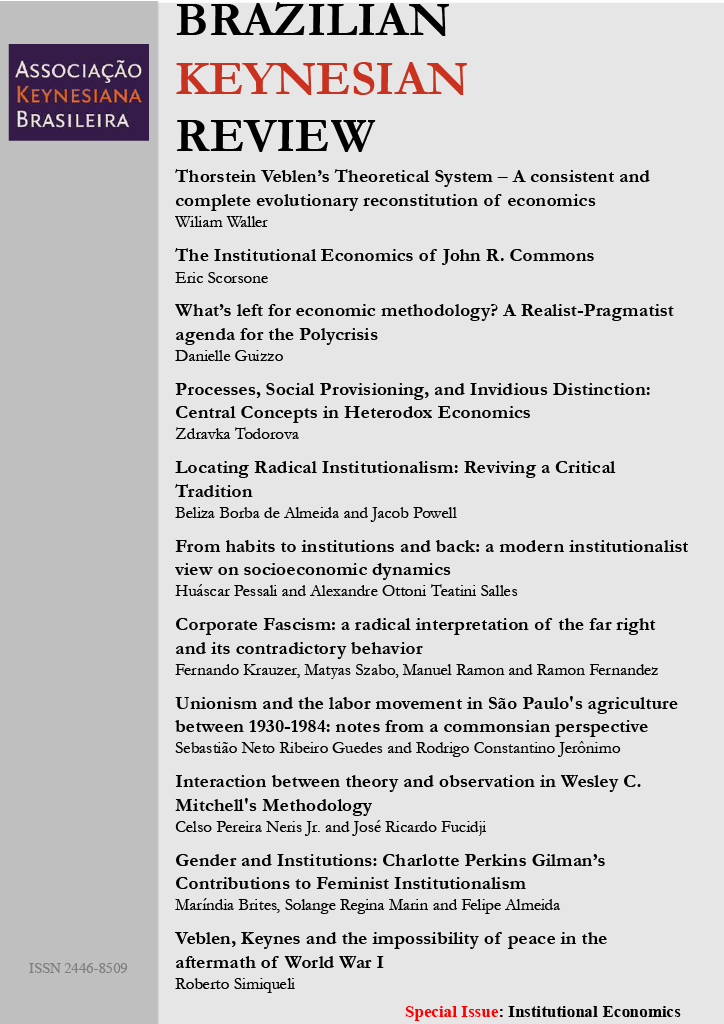
Processes, Social Provisioning, and Invidious Distinction: Central Concepts in Heterodox Economics
Keywords:
institutional economics, heterodox economics, social provisioningAbstract
Three concepts can describe the focus and method of heterodox economics: processes, social provisioning, and invidious distinction. All of these concepts are developed within original institutional economics, but are not exclusive to this approach. Although scholars use various different terminologies, processes, social provisioning, and invidious distinction distinguish heterodox economics conceptually as a different economic paradigm from mainstream economics. The conceptual presence of processes, provisioning, and invidious distinction can be seen in the roots of political economy – production, surplus, classes, and distribution. However, the development of political economy has narrowed and diminished those concepts in contemporary economic analysis. Indeed, to a large degree, the emergence of heterodox economics in its various streams is about emphasizing and developing variations of these concepts within the field of economic inquiry. At the same time, economics has broadened its coverage of topics and the scope of theories within the mainstream paradigm. The article argues that it is essential to be explicit about conceptual underpinnings to avoid conflating similar-sounding terminologies developed within fundamentally different conceptual paradigms. This does not preclude dialogue, but clarifies and strengthens the position of heterodox economics as a distinct, continuously developing economics paradigm driven by vital economic problems.
Downloads
References
Almeida, F. (2018). Revisiting “Institutions”: A Study of the Evolution of Institutional Analysis. Journal of Economic Issues, 52(2), 323–335. https://doi.org/10.1080/00213624.2018.1469861
Berik, G. & Kongar, E. (2021). The social provisioning approach in feminist economics: the unfolding research. In: G. Berik & E. Kongar (eds.), The Routledge Handbook of Feminist Economics. London: Routledge, 3–21.
Darity, William A. Jr. (2022). Position and possessions: stratification economics and intergroup inequality. Journal of Economic Literature, 60(2), 400–426.
Dengler, Corinna & Plank, Christina. (2024). Foregrounding invisible foundations: (eco-feminist perspectives on provisioning systems. Sustainability: Science, Practice and Policy, 20(1), 1–4. https://doi.org/10.1080/15487733.2024.2312667
Dugger, W. M. (1996). Redefining economics: From market allocation to social provisioning. In C. J. Whalen (Ed.), Political economy for the 21st century: Contemporary views on the trend of economics (pp. 31–43). M. E. Sharpe.
Ghilarducci, T., Knauss, Z., McGahey, R., Milberg, W., Landes, D., Nilaj, E. (2021). The Future of Heterodox Economics (Working Paper 2021-1). Schwartz Center for Economic Policy Analysis, The New School for Social Research. https://www.economicpolicyresearch.org/images/docs/research/nssr_working_papers/202101_WP_The_Future_of_Heterodox_Economics.pdf
Henry, John. (1990). The Making of Neoclassical Economics. Boston: Unwin Hyman.
Jo, Tae-Hee. (2011). Social Provisioning Process and Socio-Economic Modeling. The American Journal of Economics and Sociology, 70(5), 1094–1116. https://doi.org/10.1111/j.1536-7150.2011.00808.x
Jo, Tae-Hee. (2016). What if there are no conventional price mechanisms?. Journal of Economic Issues, 50(2), 327–344.
Jo, Tae-Hee, Lynne Chester, & Carlo D’Ippoliti (eds). (2018). The Routledge Handbook of Heterodox Economics: Theorizing, Analyzing, and Transforming Capitalism. New York: Routledge.
Jo, Tae-Hee & Zdravka Todorova. (2018). Social Provisioning Process: A Heterodox View of the Economy. In: The Routledge Handbook of Heterodox Economics: Theorizing, Analyzing, and Transforming Capitalism. New York: Routledge, 29–40.
Jochimsen, Maren & Ulrike Knobloch. (1997). Making the Hidden Visible: The Importance of Caring Activities and Their Principles for Any Economy. Ecological Economics, 20(2), 107–112. https://doi.org/10.1016/S0921-8009(95)00099-2
Kalecki, Michal. (1943). Political aspects of full employment. Political Quarterly, 14(4), 322–331.
Keynes, John M. (1936 [1964]). The General Theory of Employment, Interest, and Money. New York: Harcourt, Brace, Jovanovich.
Kyrk, Hazel. (1923). A Theory of Consumption. Boston, New York: Houghton Mifflin.
Lee, Frederic. (2009). A History of Heterodox Economics: Challenging the Mainstream in the Twentieth Century. New York: Routledge.
Lee, Frederic. (2011). Modeling the Economy as a Whole: An Integrative Approach. American Journal of Economics and Sociology, 70(5), 1282–1314.
Mitchell, Wesley C. (1912 [1937]). The Backward Art of Spending Money. In: The Backward Art of Spending Money. New York: Augustus M. Kelley, Inc, 3–19.
Mearman, Andrew, Berger, Sebastian, and Guizzo, Danielle. (2023). What is Heterodox Economics? Insights from Interviews with Leading Thinkers. Journal of Economic Issues, 57(4), 1119–1141. https://doi.org/10.1080/00213624.2023.2273130
Nelson, Julie. (1993). The study of choice or the study of provisioning? Gender and the definition of economics. In: M. Ferber & J. Nelson (eds.), Beyond Economic Man: Feminist Theory and Economics. Chicago: University of Chicago Press, 23–36.
Power, Marilyn. (2004). Social provisioning as a starting point for feminist economics. Feminist Economics, 10 (3), 3–19. https://doi.org/10.1080/1354570042000267608
Smith, Adam. (1759 [1984]). The Theory of Moral Sentiments, (eds). D. D. Raphael and A. L. Macfie. Indianapolis: Liberty Fund.
Todorova, Zdravka. (2013). Connecting Social Provisioning and Functional Finance in a Post Keynesian Institutional Analysis of the Public Sector. European Journal of Economics and Economic Policies: Intervention, 10(1), 61–75. https://doi.org/10.4337/ejeep.2013.01.06
Todorova, Zdravka. (2014). Consumption as a Social Process. Journal of Economic Issues, 48(3), 663–678. https://doi.org/10.2753/JEI0021-3624480304
Todorova, Zdravka. (2015). Social Provisioning within a Culture–Nature Life Process. Review of Political Economy, 27(3), 390–409. https://doi.org/10.1080/09538259.2015.1058090
Todorova, Zdravka. (2024). "Social Processes of Oppression in the Stratified Economy and Veblenian Feminist post Keynesian Connections," Journal of Post Keynesian Economics, 47 (1), 25-54. https://doi.org/10.1080/01603477.2023.2254504
Veblen, Thorstein. (1898 [2011]). Why is Economics not an Evolutionary Science?, in Charles Camic and Geoffrey M. Hodgson (eds.) Essential Writings of Thorstein Veblen. New York: Routledge.
Veblen, Thorstein. (1899 [1994]). The Theory of the Leisure Class: an Economic Study of Institutions, New York: Dover Publications Inc.
Veblen, Thorstein. (1919 [2005]). The Vested Interests and the Common Man. New York: Cosimo Classics.
Veblen, Thorstein. (1923). The Absentee Ownership and Business Enterprise in Recent Times: The Case of America. New York: Huebsch.
Wray, Randall. (2016). Why Minsky Matters: An Introduction to the Work of a Maverick Economist. Princeton University Press: Princeton.
Downloads
Published
How to Cite
Issue
Section
License
Copyright (c) 2026 Zdravka Todorova

This work is licensed under a Creative Commons Attribution 4.0 International License.
- Authors keep copyrights and concede to the Journal the right to the first publication, with the paper simultaneously licenced under the Creative Commons Attribution 4.0 International License which allows recognised author and journal work sharing.
- Authors are authorized to assume additional contracts separately, for non-exclusive versions of the paper published in this journal (e.g.: publish in an instituional repository or as a book chapter) with the recogntion of authorship and initial publication in this journal.
- Authors are allowed (and are estimulated) to publish and distribute their work online (e.g.: in institutional repositories or at their personal websites) at any point before or during the editorial process, once this may generate productive alterations on the paper, as well as increse the factor of impact and quotation of the published paper (please, see Free Access Effect)