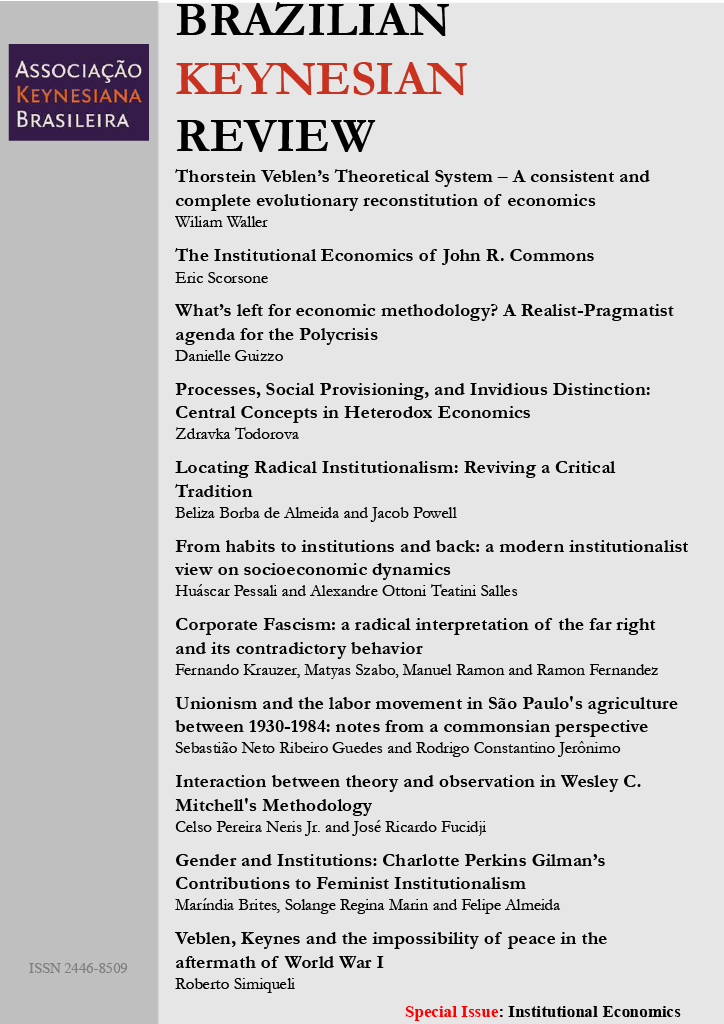
Veblen, Keynes and the impossibility of peace in the aftermath of World War I
Keywords:
Thorstein Veblen (1857–1929), John Maynard Keynes (1883–1946), World War I (1914–1918), International Relations, International Political EconomyAbstract
The Treaty of Versailles marked the end of the First World War, yet contributed to the perpetuation of conflicts and severe economic difficulties. The terms imposed on Germany amounted to what John Maynard Keynes denounced as a “Carthaginian peace” in The Economic Consequences of the Peace, in which he warned that such measures would undermine Europe’s political and economic stability. This article revisits Keynes’s critique in dialogue with Thorstein Veblen’s An Inquiry into the Nature of Peace and the Terms of Its Perpetuation, an examination of the institutional framework that made lasting peace unfeasible. For Veblen, war is not an anomaly but a development inherent to the predatory logic of absentee ownership and the vested interests of industrial capitalism. We examine Veblen’s treatment of the prospects for peace after the First World War, Keynes’s arguments in The Economic Consequences of the Peace, and convergences and divergences between the two authors, undertaking a structural reading of both works and of Veblen’s commentary on Keynes’s critique. Finally, we discuss how their interpretations of Armed Peace reveal different theoretical inspirations and the issues raised in the immediate aftermath of the war.
Downloads
References
Cain, P. J. (1978). J. A. Hobson, Cobdenism, and the Radical Theory of Economic Imperialism, 1898–1914. The Economic History Review, 31(4), 565–584.
Cain, P. J. (1981). Hobson’s Developing Theory of Imperialism. The Economic History Review, 34(2), 313–316.
Cain, P. J., & Hopkins, A. G. (1980). The Political Economy of British Expansion Overseas, 1750–1914. The Economic History Review, 33(4), 463–490.
Carr, E. H. (2001). Vinte anos de crise: 1919–1939: uma introdução ao estudo das relações internacionais (2nd ed.). Brasília: Universidade de Brasília; IPRI-FUNAG; Imprensa Oficial do Estado de São Paulo.
Dubin, M. D. (1970). Toward the Concept of Collective Security: The Bryce Group’s “Proposals for the Avoidance of War,” 1914–1917. International Organization, 24(2), 288–318.
Harrod, R. F. (1951). The life of John Maynard Keynes. London: Macmillan.
Hobsbawm, E. J. (1998). A Era dos Extremos: O breve século XX, 1914–1991. São Paulo: Companhia das Letras.
Hobson, J. A. (1902). Imperialism: a Study. James Pott & Co. http://www.econlib.org/library/YPDBooks/Hobson/hbsnImp.html
Hobson, J. A. (1909). The Crisis of Liberalism: New Issues of Democracy. London: P. S. King & Son.
Hobson, J. A. (1936). Veblen. London: Chapman Hall.
Kaiga, S. (2021). Britain and the Intellectual Origins of the League of Nations, 1914–1919. Cambridge: Cambridge University Press.
Kant, I. (1795 [2020]). À paz perpétua: um projeto filosófico (2nd ed.). Petrópolis: Vozes.
Keynes, J. M. (1919 [2019]). The economic consequences of the peace. London: Palgrave Macmillan.
Keynes, J. M. (1933). Essays in Biography. Nova York: W. W. Norton.
Keynes, J. M. (1936 [2007]). The General Theory of Employment, Interest and Money. London: Palgrave Macmillan.
Moore, B., Jr. (1993). Social Origins of Dictatorship and Democracy: Lord and Peasant in the Making of the Modern World. Boston: Beacon Press.
Shackle, G. L. S. (1991). Origens da Economia Contemporânea: Invenção e Tradição no Pensamento Econômico (1926–1939). (C. C. Miyake, Trad.). São Paulo: Hucitec.
Silva, L. O. (2003). O Imperialismo na Época da Globalização. In A. Boito Jr. & C. N. de Toledo (Eds.), Marxismo e Ciências Humanas (Vol. 1, pp. 340–360). Campinas and São Paulo: XAMÃ; FAPESP; CEMARX.
Skidelsky, R. (2003). John Maynard Keynes: 1883–1946, Economist, Philosopher, Statesman. London: Macmillan.
Skocpol, T. (1992). Protecting Soldiers and Mothers: The Political Origins of Social Policy in the United States. Cambridge: Harvard University Press.
Skocpol, T. (1995). El Estado regresa al primer plano: Estrategias de análisis en la investigación actual. In R. Grompone (Ed.), Instituciones políticas y sociedad. Lecturas introductorias (pp. 92-129). Lima: IEP.
Skocpol, T. (2015). States and Social Revolutions: A Comparative Analysis of France, Russia, and China. Cambridge: Cambridge University Press.
Skocpol, T., & Somers, M. R. (1980). The Uses of Comparative History in Macrosocial Inquiry. Comparative Studies in Society and History, 22(2), 174–197.
Spencer, H. (1891 [1981]). From freedom to bondage. In T. Mackay (Ed.), A plea for liberty: an argument against socialism and socialistic legislation (pp. 1-28). Indianapolis: Liberty Classics.
Steiner, Z. (2005). The Lights That Failed: European International History, 1919–1933. Oxford: Oxford University Press.
Thelen, K., & Steinmo, S. (1992). Historical Institutionalism in Comparative Politics. In S. Steinmo, K. Thelen, & F. Longstreth (Eds.), Structuring Politics: Historical Institutionalism in Comparative Analysis (pp. 1–32). Cambridge: Cambridge University Press.
Veblen, T. B. (1899 [1994]). The Theory of the Leisure Class: An Economic Study of Institutions. London: Routledge/Thoemmes Press.
Veblen, T. B. (1904 [1932]). The Theory of Business Enterprise. New York: Charles Scribner’s Sons.
Veblen, T. B. (1915 [1994]). Imperial Germany and the Industrial Revolution. London: Routledge/Thoemmes Press.
Veblen, T. B. (1917). An Inquiry into the Nature of Peace and the Terms of its Perpetuation. London: Macmillan.
Veblen, T. B. (1919 [1994]). The Place of Science in Modern Civilization. In P. Cain (Ed.), The Collected Works of Thorstein Veblen (Vol. 8). London: Routledge.
Veblen, T. B. (1920). The economic consequences of the peace, by John Maynard Keynes [Book review]. Political Science Quarterly, 35(3), 467–472.
Veblen, T. B. (1921 [1994]). The engineers and the price system. In P. Cain (Ed.), The collected works of Thorstein Veblen (Vol. 7). London: Routledge.
Veblen, T. B. (1919 [1994]). The Vested Interests and the Common Man. In P. Cain (Ed.), The Collected Works of Thorstein Veblen (Vol. 7). London: Routledge.
Wilson, W. (1918, January 8). Fourteen Points [Speech]. The Avalon Project, Yale Law School. https://avalon.law.yale.edu/20th_century/wilson14.asp
Downloads
Published
How to Cite
Issue
Section
License
Copyright (c) 2026 Roberto Simiqueli

This work is licensed under a Creative Commons Attribution 4.0 International License.
- Authors keep copyrights and concede to the Journal the right to the first publication, with the paper simultaneously licenced under the Creative Commons Attribution 4.0 International License which allows recognised author and journal work sharing.
- Authors are authorized to assume additional contracts separately, for non-exclusive versions of the paper published in this journal (e.g.: publish in an instituional repository or as a book chapter) with the recogntion of authorship and initial publication in this journal.
- Authors are allowed (and are estimulated) to publish and distribute their work online (e.g.: in institutional repositories or at their personal websites) at any point before or during the editorial process, once this may generate productive alterations on the paper, as well as increse the factor of impact and quotation of the published paper (please, see Free Access Effect)