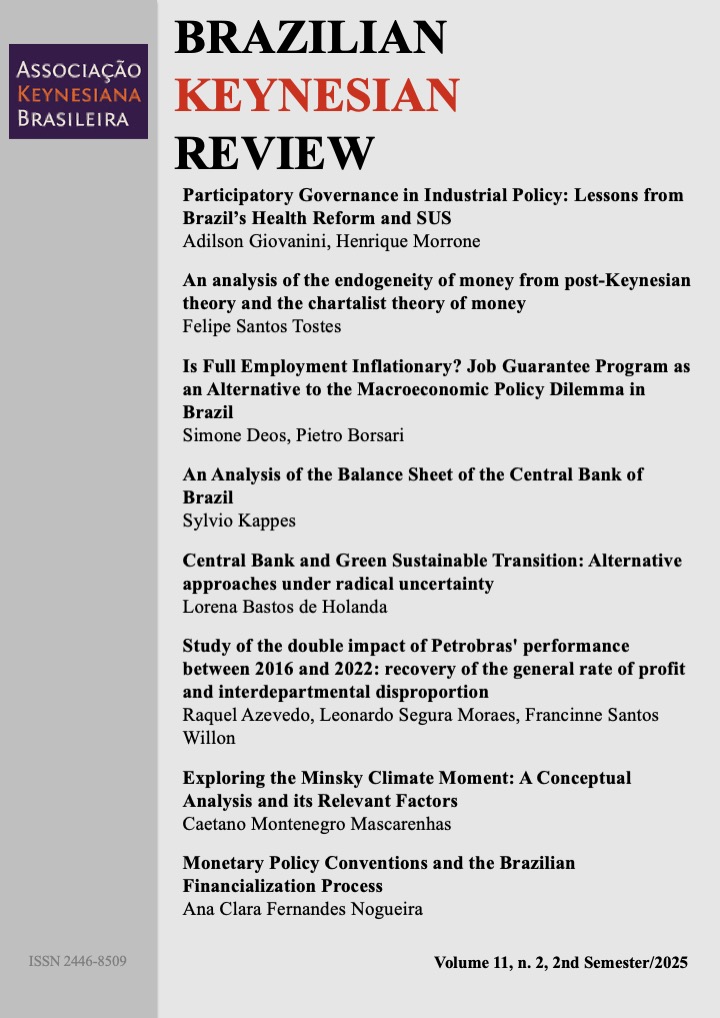
Central Bank and Green Sustainable Transition
Alternative approaches under radical uncertainty
DOI:
https://doi.org/10.33834/bkr.v11i2.365Keywords:
Central Banks, Radical Uncertainty, Green-Sustainable TransitionAbstract
The article discusses the vulnerability of the financial system in the face of the climate crisis and examines the ability of central banks to act as proactive agents in the green-sustainable transition. It argues that climate-related financial risks (CRFR) are systemic, endogenous, and marked by radical uncertainty, which makes them incompatible with conventional supervision models. Based on a review of the literature, the text examines the channels of transmission of the climate crisis to the financial system, highlighting the paradoxes between physical and transition risks. It then analyses two alternative regulatory approaches: the market fixing approach, focused on transparency and risk pricing, and the market shaping approach, based on the precautionary principle and macroprudential and allocative policies. The article highlights the implications of each perspective and points out the dilemmas faced by monetary authorities in light of the urgency of the sustainable green transition
Downloads
References
Andrade, R. (2011). A construção do conceito de incerteza: uma comparação das contribuições de Knight, Keynes, Shackle e Davidson, Nova Economia, 21, 171-195. DOI: 10.1590/S0103-63512011000200001.
Batten, S., Sowerbutts, R., & Tanaka, M. (2016). Let’s talk about the weather: the impact of climate change on central banks, Bank of England Staff Working Paper, n. 603.
BCE – Banco Central Europeu. (2020). Guia sobre riscos climáticos e ambientais – Expectativas prudenciais relacionadas com a gestão e a divulgação de riscos, Frankfurt am Main: Banco Central Europeu.
Berr, E. (2017). Post Keynesian economics and sustainable development. In C. Spash (Ed.), Routledge Handbook of Ecological Economics, London: Routledge, p. 67-76.
Bolton, P., Despres, M., Pereira da Silva, L. A., Samama, F. & Svartzman, R. The green swan: Central banking in the age of climate change. Basel: Bank for International Settlements (BIS), 2020. Disponível em: <https://www.bis.org/publ/othp31.pdf>.
Campiglio, E. (2016). Beyond carbon pricing: The role of banking and monetary policy in financing the transition to a low-carbon economy. Ecological Economics, 121, 220-230. DOI: 10.1016/j.ecolecon.2015.03.020.
Campiglio, E., Dafermos, Y., Monnin, P., Ryan-Collins, J., Schotten, G., & Tanaka, M. (2018). Climate change challenges for central banks and financial regulators. Nature Climate Change, 8(6), 462-468. DOI: 10.1038/s41558-018-0175-0.
Carney, M. (2015). Breaking the tragedy of the horizon – climate change and financial stability. Lloyd's of London.
Carney, M. (2018). A Transition in Thinking and Action. International Climate Risk Conference for Supervisors, De Nederlandsche Bank.
Chenet, H., Ryan-Collins, J., & Van Lerven, F. (2021). Finance, climate-change and radical uncertainty: Towards a precautionary approach to financial policy. Ecological Economics, 183, 106957. DOI: 10.1016/j.ecolecon.2021.106957.
Christophers, B. (2019). Environmental beta or how institutional investors think about climate change and fossil fuel risk. Annals of the American Association of Geographers, 109(3), 754-774. DOI: 10.1080/24694452.2018.1489213.
Crocco, M., & Feil, F. F. (2021). Um ensaio sobre riscos ambientais e a estabilidade do sistema financeiro: o caso do Brasil no pós-pandemia. In G. Bercovici, J. Sicsú, & R. Aguiar (Orgs.), Utopias para reconstruir o Brasil, São Paulo: Quartier Latin, p. 743-759.
Crona, B., Folke, C., & Galaz, V. (2021). The Anthropocene reality of financial risk. One Earth, 4(5), 618-628. DOI: 10.1016/j.oneear.2021.04.016.
Dafermos, Y. (2021). Climate change, central banking and financial supervision: beyond the risk exposure approach, SOAS Department of Economics Working Paper, n. 242.
Dikau, S., & Volz, U. (2021). Central bank mandates, sustainability objectives and the promotion of green finance. Ecological Economics, v. 184 (107022). DOI: 10.1016/j.ecolecon.2021.107022
Feil, F., Feijó, C., & Horn, C. H. (No prelo) Development Banks and the Green Transition: Financing the Sustainable Development Convention. Routledge.
Gabor, D., & Braun, B. (2025). Green macrofinancial regimes. Review of international political economy, 32(3), p. 542-568. DOI: 10.1080/09692290.2025.2453504.
Henry, C., & Henry, M. (2002). Formalization and applications of the precautionary principles, Columbia University Discussion Paper No. 0102-22. DOI: 10.2139/ssrn.1084972.
IPCC – Intergovernmental Panel on Climate Change (2014). Mitigation of climate change. Contribution of Working Group III to the Fifth Assessment Report of the Intergovernmental Panel on Climate Change. Cambridge: Cambridge University Press. Disponível em: https://www.ipcc.ch/report/ar5/wg3/
IPCC – Intergovernmental Panel on Climate Change. (2023). Climate Change 2023: Synthesis Report. Contribution of Working Groups I, II and III to the Sixth Assessment Report of the Intergovernmental Panel on Climate Change. Genebra: IPCC. DOI: 10.59327/IPCC/AR6-9789291691647.
ISSB – International Sustainability Standards Board (2023). IFRS S2 Climate-related Disclosures. London: IFRS Foundation.
International Financial Reporting Standards Foundation (2023). ISSB issues inaugural global sustainability disclosure standards: IFRS S1 and IFRS S2. London: IFRS Foundation, 2023. Disponível em: https://www.ifrs.org/news-and-events/news/2023/06/issb-issues-ifrs-s1-ifrs-s2/. Acesso em: 30 de julho de 2025.
Kedward, K., Gabor, D., & Ryan-Collins, J. (2022). Aligning finance with the green transition: From a risk-based to an allocative green credit policy regime. UCL Institute for Innovation and Public Purpose Working Paper, n. 2022/11. DOI: 10.2139/ssrn.4198146.
Kedward, K., Gabor, D., & Ryan-Collins, J. (2024). Carrots with(out) sticks: Credit policy and the limits of green central banking. Review of International Political Economy, 31(5), p. 1593-1617. DOI: 10.1080/09692290.2024.2351838.
Kedward, K., Ryan-Collins, J., & Chenet, H. (2020). Managing nature-related financial risks: A precautionary policy approach for central banks and financial supervisors. UCL Institute for Innovation and Public Purpose Working Paper, n. 2020/09. DOI: 10.2139/
ssrn.3726637
Krogstrup, S.; Oman, W. (2019). Macroeconomic and financial policies for climate change mitigation: A review of the literature. IMF Working Paper, n. 19 (185).
Mendonça, A. R., Feil, F., & Pessoa, L. (2022). Regulação financeira e bancos de desenvolvimento: reflexões sobre a construção de finanças sustentáveis. Anais do XV Encontro Internacional da Associação Keynesiana Brasileira, Belo Horizonte.
Minsky, H.(2008). Stabilizing an unstable economy (1ª Ed.). New York: McGraw-Hill.
Müeller, C. C. (2007). Os economistas e as relações entre o sistema econômico e o meio ambiente (1ª Ed.). Brasília: Editora UnB.
NFGS – Network For Greening The Financial System. (2019). First comprehensive report: Climate change as a source of financial risk.
NFGS – Network For Greening The Financial System. (2023). Recommendations toward the development of scenarios for assessing nature-related economic and financial risks.
NFGS – Network For Greening The Financial System. (2024a). Acute physical impacts from climate change and monetary policy.
NFGS – Network For Greening The Financial System. (2024b). Nature-related financial risks: A conceptual framework to guide action by central banks and supervisors.
Oman, W., Salin, M., & Svartzman, R. (2024). Three tales of central banking and financial supervision for the ecological transition. WIREs Climate Change, 15(3), e876. DOI: 10.1002/wcc.876.
ONU – Organização das Nações Unidas. (1992). Declaração do Rio sobre Meio Ambiente e Desenvolvimento. Nova York: ONU. Disponível em: www.un.org/en/conferences/
environment/rio1992, acesso em 23 de outubro de 2025.
Ryan-Collins, J. (2019). Beyond voluntary disclosure: Why a ‘market-shaping’ approach to financial regulation is needed to meet the challenge of climate change, SUERF Policy Note, n. 61.
Santos, L. H. B., & Andrade, D. C. (2023). A aproximação entre economia pós-keynesiana e economia ecológica: apreciação crítica e considerações sobre o financiamento verde. Brazilian Keynesian Review, 9(2), p. 368-401.
Schneider, M. E. N. A. C., Porto, R. P., Trabacchi, M. C., Schneider, S., Harb, S., & Smallridge, D. (2021). A guidebook for national development banks on climate risk. Nova Iorque: Banco Interamericano de Desenvolvimento.
Svartzman, R., Bolton, P., Despres, M., Da Silva, L. A. P., & Samama, F. (2020). Central banks, financial stability and policy coordination in the age of climate uncertainty: A three-layered analytical and operational framework. Climate Policy, 21, p. 563-580. DOI: 10.1080/14693062.2020.1862743.
Taleb, N. N. (2008). The black swan: The impact of the highly improbable (1ª Ed.). Nova York: Penguin Random House.
TCFD – Task Force on Climate-related Financial Disclosures. (2017). Final report: Recommendations of the Task Force on Climate-related Financial Disclosures.
TNFD – Taskforce on Nature-related Financial Disclosures. (2023). Recommendations of the Taskforce on Nature-related Financial Disclosures. London: TNFD.
UNFCCC – United Nations Framework Convention on Climate Change. (2015). The Paris Agreement. Disponível em: https://unfccc.int/process-and-meetings/the-paris-agreement, acesso em 30 de julho de 2025.
WEF – World Economic Forum. (2023). Annual report (2022-2023). Genebra: World Economic Forum.
WHO – World Health Organization. (2004). The precautionary principle: Protecting public health, the environment and the future of our children.
World Bank. (2024). State and trends of carbon pricing 2024. Washington, DC: World Bank.
Downloads
Published
How to Cite
Issue
Section
License
- Authors keep copyrights and concede to the Journal the right to the first publication, with the paper simultaneously licenced under the Creative Commons Attribution 4.0 International License which allows recognised author and journal work sharing.
- Authors are authorized to assume additional contracts separately, for non-exclusive versions of the paper published in this journal (e.g.: publish in an instituional repository or as a book chapter) with the recogntion of authorship and initial publication in this journal.
- Authors are allowed (and are estimulated) to publish and distribute their work online (e.g.: in institutional repositories or at their personal websites) at any point before or during the editorial process, once this may generate productive alterations on the paper, as well as increse the factor of impact and quotation of the published paper (please, see Free Access Effect)