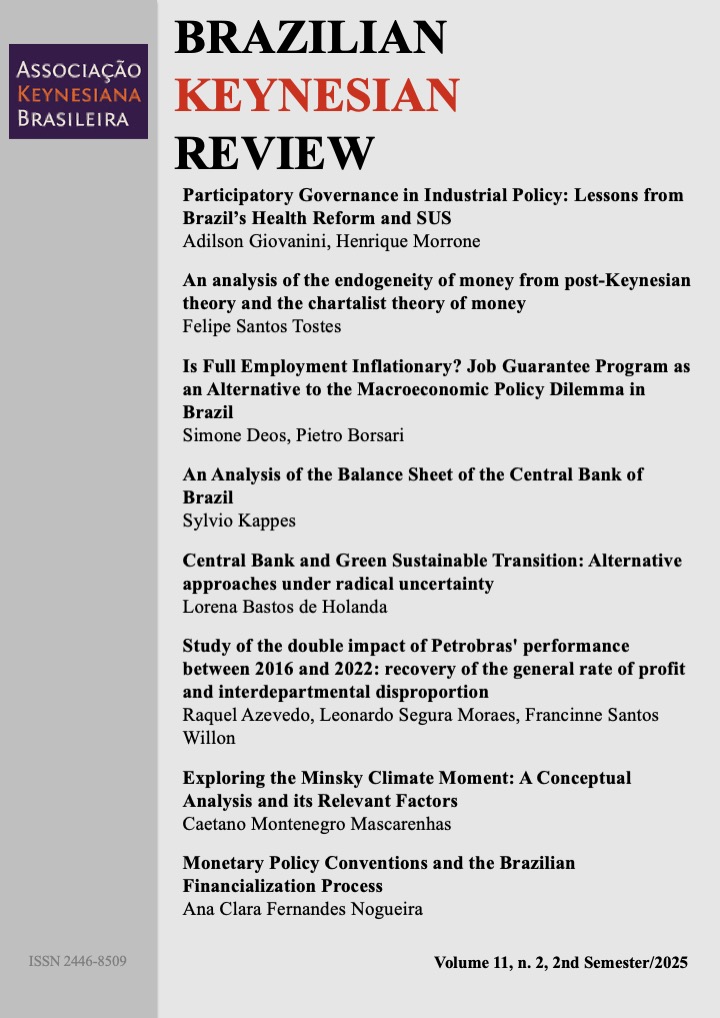
Participatory Governance in Industrial Policy:
Lessons from Brazil’s Health Reform and SUS
DOI:
https://doi.org/10.33834/bkr.v11i2.391Keywords:
Industrial Policy, Healthcare reform, SUS, Decentralization, Social participationAbstract
International experience underscores the importance of participatory arenas in building resilient industrial policies (IPs). In Brazil, however, IPs suffer from institutional fragmentation, centralized decision-making, and limited engagement with civil society. This article investigates how the institutional architecture developed through the health reform and the Unified Health System (SUS) can offer valuable lessons for enhancing the participatory governance of industrial policy, with particular focus on the National Council of Industry (CNI) and the National Council for Industrial Development (CNDI). Drawing on a historical analysis, the study mobilizes three analytical dimensions (articulation capacity, representative cohesion, and conflict mediation) to examine the constraints on institutional stability. The findings suggest that weaknesses in these dimensions undermine the resilience and legitimacy of Brazilian industrial policy. The study highlights the need to redesign participatory arenas, decentralize decision-making, and institutionalize enduring mechanisms for consensus-building and monitoring, in order to ensure the continuity and effectiveness of Brazil’s neo-industrialization strategies.
Downloads
References
Brasil. (2023). Decreto nº 11.482, de 6 de abril de 2023: Dispõe sobre o Conselho Nacional de Desenvolvimento Industrial - CNDI. Diário Oficial da União. https://www.in.gov.br/web/dou/-/decreto-n-11.482-de-6-de-abril-de-2023-475785896
Bresser-Pereira, L. C. (2007). Estratégia nacional-desenvolvimentista. Revista de Economia Política, 27(2), p.233–255.
Cabria, J. V. B. (2024). Industrial policy and state-business relations in Brazil: The governance of productive development policies. Revista Contribuciones a las Ciencias Sociales, 17(12), p.1–26.
Capistrano Filho, D., & Pimenta, A. L. (1988). Saúde para todos: Um desafio ao município. A resposta de Bauru. In Saúde para todos: Um desafio ao município. A resposta de Bauru (pp. 207–207
Chang, H.-J. (1999). The economic theory of the developmental state. In M. Woo-Cumings (Ed.), The developmental state (pp. xx–xx). Ithaca, NY: Cornell University Press.
Chang, H.-J. (2003). Kicking away the ladder: Infant industry promotion in historical perspective. Oxford Development Studies, 31(1), 21–32.
Cimoli, M., Dosi, G., & Stiglitz, J. E. (2009). Industrial policy and development: The political economy of capabilities accumulation. Oxford: Oxford University Press.
Suzigan, W., Garcia, R., & Assis Feitosa, P. H. (2020). Institutions and industrial policy in Brazil after two decades: Have we built the needed institutions? Economics of Innovation and New Technology, 29(7), p.799–813. DOI: 10.1080/10438599.2020.1719629
Costa, N. do R. (2014). Comunidade epistêmica e a formação da reforma sanitária no Brasil. Physis: Revista de Saúde Coletiva, 24, p.809–829. DOI:10.1590/S0103-73312014000300008
Coutinho, L. (2015). Governança e políticas industriais no Brasil. Revista do BNDES, 42(1), p. 25–42.
De Toni, J. (2013). Novos arranjos institucionais na política industrial do governo Lula: A força das novas ideias e dos empreendedores políticos [Tese de doutorado, Universidade de Brasília].
Dowbor, M. (2018). Escapando das incertezas do jogo eleitoral: A construção de encaixes e domínio de agência do movimento municipalista de saúde. In Movimentos sociais e institucionalização (p. 89).
Escorel, S., Nascimento, D. R. do, & Edler, F. C. (2005). As origens da reforma sanitária e do SUS. In Saúde e democracia: História e perspectivas do SUS (pp. xx–xx). Rio de Janeiro: Editora Fiocruz.
Evans, P. (1995). Embedded autonomy: States and industrial transformation. Princeton: Princeton University Press.
Faria, C. E. de. (2017). O papel da Confederação Nacional da Indústria na política industrial brasileira (1938–2014) [Tese de doutorado, Universidade de Brasília].
Fleury, S. (2009). Saúde e democracia: A luta do CEBES. São Paulo: Lemos Editorial.
Gomide, A. A., De Toni, A. P., & Giesteira, C. J. S. (2025). Capacidades estatais e articulação público-privada na política industrial: O que aprendemos com o Brasil? Revista do Serviço Público, 76(4), p.1–30
Hausmann, R., Rodrik, D., & Sabel, C. (2008). Reconfiguring industrial policy: A framework with an application to South Africa. CID Working Paper, 168. Harvard University.
Karo, E., & Kattel, R. (2018). The new global division of innovation labor: Causes and consequences. Industry and Innovation, 25(7), p.648–666. DOI: 10.1080/13662716.2018.1440986
Lotta, G. S., & Vaz, J. C. (2015). Arranjos institucionais de políticas públicas: Aprendizados a partir de casos de arranjos institucionais complexos no Brasil. Revista do Serviço Público, 66(2), p.171–194.
Mazzucato, M. (2011). The entrepreneurial state. Soundings, 49, p. 131–142.
Mazzucato, M. (2021). Mission economy: A moonshot guide to changing capitalism. London: Penguin UK.
Musacchio, A., & Lazzarini, S. G. (2015). Reinventando o capitalismo de Estado: O Leviatã nos negócios: Brasil e outros países. São Paulo: Portfolio-Penguin.
Paim, J. S. (2007). A reforma sanitária brasileira: Contribuição para a compreensão e crítica da trajetória da política de saúde no Brasil. Rio de Janeiro: Editora Fiocruz.
Paim, J. S., et al. (2011). The Brazilian health system: History, advances, and challenges. The Lancet, 377(9779), p. 1778–1797.
Rodrik, D. (2004). Industrial policy for the twenty-first century. CEPR Discussion Paper Series, 4767
Schneider, B. R. (2004). Business politics and the state in twentieth-century Latin America. Cambridge: Cambridge University Press.
Schneider, B. R. (2015). Designing industrial policy in Latin America: Business-state relations and the new developmentalism. Journal of Politics in Latin America, 5(1),p. 3–39.
Schmitz, H. (2007). Reducing complexity in the industrial policy debate. Development Policy Review, 25(4), p. 417–428.
Stein, G. Q., & Gugliano, A. A. (2017). Capacidades políticas e política industrial: A experiência brasileira no século XXI. Anais do Encontro Anual da ANPOCS – GT Políticas Públicas, 41.
Wade, R. (1990). Industrial policy in East Asia: Does it lead or follow the market? In G. Gereffi & D. Wyman (Eds.), Manufacturing miracles: Paths of industrialization in Latin America and East Asia (pp. 231–266). Princeton University Press. DOI: 10.1515/9781400862030.231
Downloads
Published
How to Cite
Issue
Section
License
- Authors keep copyrights and concede to the Journal the right to the first publication, with the paper simultaneously licenced under the Creative Commons Attribution 4.0 International License which allows recognised author and journal work sharing.
- Authors are authorized to assume additional contracts separately, for non-exclusive versions of the paper published in this journal (e.g.: publish in an instituional repository or as a book chapter) with the recogntion of authorship and initial publication in this journal.
- Authors are allowed (and are estimulated) to publish and distribute their work online (e.g.: in institutional repositories or at their personal websites) at any point before or during the editorial process, once this may generate productive alterations on the paper, as well as increse the factor of impact and quotation of the published paper (please, see Free Access Effect)