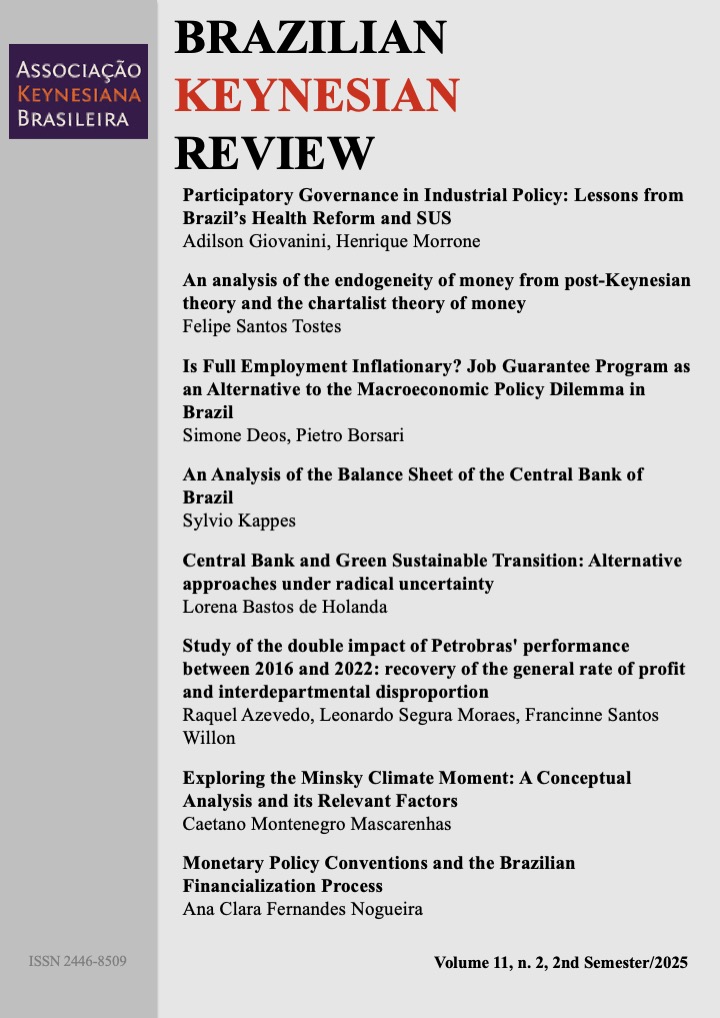
Study of the double impact of Petrobras' performance between 2016 and 2022
recovery of the general rate of profit and interdepartmental disproportion
DOI:
https://doi.org/10.33834/bkr.v11i2.393Keywords:
Petrobras, general rate of profit, interdepartmental disproportionAbstract
Considering both Maria da Conceição Tavares’ formulation that Brazilian crises are due to the decline in the diffusion capacity of dynamic sectors, and the historical role of Petrobras in the process of import substitution industrialization through its purchasing policy aimed at the domestic market, the objective of this paper is to analyze the consequences of the 2014-2015 crisis based on the effects of the new policy established for Petrobras in 2016 by Michel Temer's government and consolidated in the subsequent government of Jair Bolsonaro. From 2016 onwards, the company’s guideline began to be guided by the reduction of internal purchasing requirements and the sale of assets in the refining segment. The double impact of these policies are, on the one hand, the recovery of the general rate of profit of the Brazilian economy and, on the other, the maintenance of a high disproportion between production departments. The methodology adopted in this work is the translation of companies’ accounting data into Marx’s economic theory through the Marxist Study of Added Values database.
Downloads
References
Azevedo, R. (2004). Análise dos ciclos da economia brasileira em Formação Econômica do Brasil de Celso Furtado a partir dos esquemas de reprodução de Marx. Revista da Sociedade Brasileira de Economia Política, 70, p. 114-137.
Azevedo, R; Moraes, L. S. (2024). Os esquemas de reprodução de Marx enquanto ferramenta econômica: uma análise da economia brasileira entre 2010 e 2021. In: XXIX Encontro Nacional de Economia Política (ENEP), Marabá.
Foley, D. K. (1986). Understanding Capital: Marx’s Economic Theory. Cambridge: Harvard University Press.
Furtado, C. (1969 [2019]). A economia latino-americana: formação histórica e problemas contemporâneos. 5. ed. São Paulo: Companhia das Letras.
Kliman, A. (2007). Reclaiming Marx’s “Capital”: A Refutation of the Myth of Inconsistency. Lexington Books: Lanham.
Mandarini, M.; Toscano, A. (2020). Planing for conflict. South Atlantic Quarterly, 119(1), p. 11-30.
Marx, K. (1894 [2008b]). O Capital: crítica da economia política. Tradução: Reginaldo Sant’Anna. Rio de Janeiro: Civilização Brasileira. 4.
Moseley, F. (2017). Money and Totality: A Macro-Monetary Interpretation of Marx’s Logic in Capital and the End of the ‘Transformation Problem’. Leiden: Brill.
Moraes, L. S.; Azevedo, R. (2022). Notas para um estudo marxista dos valores adicionados na economia brasileira contemporânea (2010-2021). Nexos Econômicos, 16(1), p. 163-194.
Mortari, V. S., da Silva, C. G. R. S., Loural, M., & Oliveira, M. A. S. (2021). A Petrobras como agente do desenvolvimento produtivo no Brasil:: importância e esvaziamento. Revista da Sociedade Brasileira de Economia Política, p.143-176.
Ribeiro, C. G.; Novaes, H. T. (2016). Petrobras 60 años: avances y retrocesos en el desarrollismo brasileño. América Latina Hoy, 72, p. 41-58.
Tavares, M. da C. (1972 [1975]). Da substituição de importações ao capitalismo financeiro: ensaios sobre Economia Brasileira. 4. ed. Rio de Janeiro: Zahar.
Downloads
Published
How to Cite
Issue
Section
License
- Authors keep copyrights and concede to the Journal the right to the first publication, with the paper simultaneously licenced under the Creative Commons Attribution 4.0 International License which allows recognised author and journal work sharing.
- Authors are authorized to assume additional contracts separately, for non-exclusive versions of the paper published in this journal (e.g.: publish in an instituional repository or as a book chapter) with the recogntion of authorship and initial publication in this journal.
- Authors are allowed (and are estimulated) to publish and distribute their work online (e.g.: in institutional repositories or at their personal websites) at any point before or during the editorial process, once this may generate productive alterations on the paper, as well as increse the factor of impact and quotation of the published paper (please, see Free Access Effect)