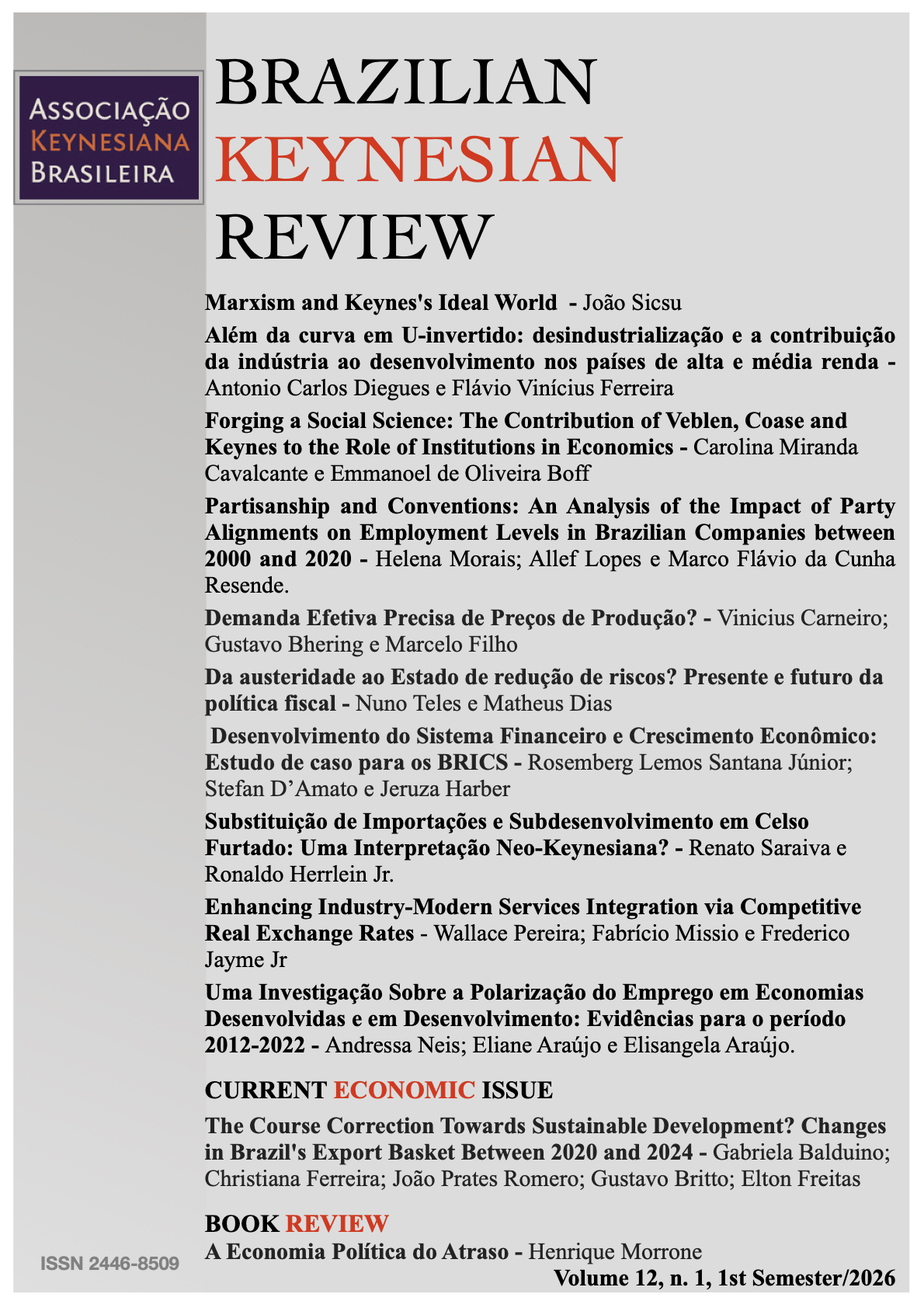
Beyond the inverted-U curve:
desindustrialisation and the limits of industry’s contribution to development in high and middle income countries.
DOI:
https://doi.org/10.33834/bkr.v12i1.413Keywords:
Industry and Development, Structural change, Deindustrialization, High-income countries, Middle-income countriesAbstract
Based on the understanding of development as a process of accumulation and investment linked to technological progress and structural transformation, this paper analyzes the industry’s contribution to development in high-income countries (HICs) and middle-income countries (MICs) between 2000 and 2019. It reassesses the validity of the inverted-U hypothesis initially proposed by Rowthorn through an innovative approach: evaluating industrial sectors by technological intensity using structural productivity decomposition. The findings show that none of the empirical exercises confirmed the presence of an inverted-U relationship between productivity growth and per capita income levels, whether in HICs or MICs. The most recurrent patterns were: (i) a positive exponential relationship; and (ii) a traditional U-shaped curve. Therefore, the results indicate that the industry's contribution to development has not declined with increasing per capita income levels.
Downloads
References
Aiginger, K., & Rodrik, D. (2020). Rebirth of industrial policy and an agenda for the twenty-first century. Journal of Industry, Competition and Trade, 20, 189–207.
Andreoni, A., & Chang, H.-J. (2017). Bringing production and employment back into development: Alice Amsden’s legacy for a new developmentalist agenda. Cambridge Journal of Regions, Economy and Society, 10(1), 173–187.
Andreoni, A., & Gregory, M. (2013). Why and how does manufacturing still matter: Old rationales, new realities. Revue d’Économie Industrielle, 144, 21–57.
Andreoni, A., & Tregenna, F. (2018). Stuck in the middle: Premature deindustrialisation and industrial policy (CCRED Working Paper No. 11).
Andreoni, A., & Chang, H.-J. (2019). The political economy of industrial policy: Structural interdependencies, policy alignment and conflict management. Structural Change and Economic Dynamics, 48, 136–150.
Andreoni, A., & Tregenna, F. (2019). Beyond the inverted U: The changing nature and structural heterogeneity of premature de-industrialisation. In International Workshop: The Future of Industrial Work: New Pathways and Policies of Structural Transformation.
Andreoni, A., & Tregenna, F. (2020). Escaping the middle-income technology trap: A comparative analysis of industrial policies in China, Brazil and South Africa. Structural Change and Economic Dynamics, 54, 324–340.
Castillo, M., & Martins, A. (2016). Premature deindustrialization in Latin America (Production Development Series No. 205). ECLAC.
Chang, H.-J., & Andreoni, A. (2020). Industrial policy in the 21st century. Development and Change, 51(2), 324–351.
Chang, H.-J., & Andreoni, A. (2021). Bringing production back into development: An introduction. The European Journal of Development Research, 33, 165–178.
Cherif, R., & Hasanov, F. (2019). The return of the policy that shall not be named: Principles of industrial policy. International Monetary Fund.
De Vries, G., Timmer, M. P., & De Vries, K. (2015). Structural transformation in Africa: Static gains, dynamic losses. The Journal of Development Studies, 51(6), 674–688.
Diegues, A. C., Pereira, A. J., & Hiratuka, C. (2023). Chinese developmental state uniqueness: An interpretation based on productive development policies and the dynamics of institutional change (Texto para Discussão No. 449). Instituto de Economia, Universidade Estadual de Campinas.
Diegues, A. C., & Rossi, C. G. (2020). Beyond deindustrialization: Changes in the pattern of industry organization and accumulation in a scenario of the “Brazilian disease”. Economia e Sociedade, 29, 1–28.
DiPippo, G., et al. (2022). Red ink: Estimating Chinese industrial policy spending in comparative perspective. Center for Strategic and International Studies.
Dosi, G., Riccio, F., & Virgillito, M. E. (2021). Varieties of deindustrialization and patterns of diversification: Why microchips are not potato chips. Structural Change and Economic Dynamics, 57, 182–202.
Evenett, S., et al. (2024). The return of industrial policy in data (IMF Working Paper). International Monetary Fund.
Fabricant, S. (1942). Employment in manufacturing, 1899–1939: An analysis of its relation to the volume of production. National Bureau of Economic Research.
Fagerberg, J. (2000). Technological progress, structural change and productivity growth: A comparative study. Structural Change and Economic Dynamics, 11, 393–411.
Felipe, J., Mehta, A., & Rhee, C. (2018). Manufacturing matters—but it’s the jobs that count. Cambridge Journal of Economics, 43(1), 139–168.
Furtado, C. (1964). Development and underdevelopment. University of California Press.
Galindo-Rueda, F., & Verger, F. (2016). OECD taxonomy of economic activities based on R&D intensity. OECD.
Gerschenkron, A. (1962). Economic backwardness in historical perspective. In A. Gerschenkron, Economic backwardness in historical perspective. Harvard University Press.
Hamilton, A. (1913). Report on manufactures (1791). U.S. Senate Documents, 22(172). (Trabalho original publicado em 1791)
Haraguchi, N. (2015). Patterns of structural change and manufacturing development. In Routledge handbook of industry and development (pp. 38–64). Routledge.
Hirschman, A. O. (1958). The strategy of economic development. Yale University Press.
Kaldor, N. (1966). Causes of the slow rate of economic growth of the United Kingdom.
Kaldor, N. (1967). Problems of industrialization in underdeveloped countries. In Strategic factors in economic development (pp. 53–72).
Lee, K. (2019). The art of economic catch-up: Barriers, detours and leapfrogging in innovation systems. Cambridge University Press.
List, F. (1841). The national system of political economy.
Mazzucato, M., Kattel, R., & Ryan-Collins, J. (2020). Challenge-driven innovation policy: Towards a new policy toolkit. Journal of Industry, Competition and Trade, 20, 421–437.
Mazzucato, M., & Rodrik, D. (2023). Industrial policy with conditionalities: A taxonomy and sample cases (IIPP Working Paper Series No. 7). UCL Institute for Innovation and Public Purpose.
McMillan, M. S., & Rodrik, D. (2011). Globalization, structural change and productivity growth (NBER Working Paper No. 17143). National Bureau of Economic Research.
Morceiro, P. C. (2021). Methodological influence on Brazilian deindustrialization. Brazilian Journal of Political Economy, 41(4), 700–722.
OECD. (1987). Structural adjustment and economic performance. OECD.
Özçelik, E., & Özmen, E. (2023). Premature deindustrialisation: The international evidence. Cambridge Journal of Economics, 1–22.
Palma, G. (2005). Four sources of de-industrialisation and a new concept of the Dutch disease. In Beyond reforms: Structural dynamics and macroeconomic vulnerability (Vol. 3, No. 5, pp. 71–116).
Palma, J. G. (2008). Deindustrialisation, premature deindustrialisation, and the Dutch disease. In L. E. Blume & S. N. Durlauf (Eds.), The New Palgrave dictionary of economics (2nd ed., pp. 401–410). Palgrave Macmillan.
Palma, J. G. (2009). Flying-geese and waddling-ducks: The different capabilities of East Asia and Latin America to demand-adapt and supply-upgrade their export productive capacity. In Industrial policy in developing countries. Oxford University Press.
Rodrik, D. (2016). Premature deindustrialization. Journal of Economic Growth, 21, 1–33.
Rodrik, D. (2017). Premature deindustrialisation in the developing world. Frontiers of Economics in China, 12(1), 1–34.
Rosenstein-Rodan, P. N. (1943). Problems of industrialisation of Eastern and South-Eastern Europe. The Economic Journal, 53(210–211), 202–211.
Rowthorn, B. (1995). Korea at the crossroads. ESRC Centre for Business Research, University of Cambridge.
Rowthorn, R. E., & Ramaswamy, R. (1999). Growth, trade, and deindustrialization. IMF Staff Papers, 46(1), 18–41.
Rowthorn, R. E., & Ramaswamy, R. (1997). Deindustrialization: Causes and implications. International Monetary Fund.
Schumpeter, J. A. (1934). The theory of economic development. Harvard University Press.
Thirlwall, A. P. (1979). The balance of payments constraint as an explanation of international growth rates. Banca Nazionale del Lavoro Quarterly Review.
Timmer, M. P., & De Vries, G. J. (2009). Structural change and growth accelerations in Asia and Latin America: A new sectoral data set. Cliometrica, 3, 165–190.
Tregenna, F. (2009). Characterising deindustrialisation: An analysis of changes in manufacturing employment and output internationally. Cambridge Journal of Economics, 33(3), 433–466.
Tregenna, F. (2016). Deindustrialization and premature deindustrialization. In J. Ghosh, R. Kattel, & E. Reinert (Eds.), Elgar handbook of alternative theories of economic development. Edward Elgar.
Tregenna, F., & Andreoni, A. (2020). Deindustrialisation reconsidered: Structural shifts and sectoral heterogeneity (Working Paper Series). UCL Institute for Innovation and Public Purpose.
United Nations Industrial Development Organization. (2010). Industrial statistics: Guidelines and methodology. UNIDO.
Vu, K., Haraguchi, N., & Amann, J. (2021). Deindustrialization in developed countries amid accelerated globalization: Patterns, influencers, and policy insights. Structural Change and Economic Dynamics, 59, 454–469.
Downloads
Published
How to Cite
Issue
Section
License
Copyright (c) 2026 Antonio Carlos Diegues, Flávio Vinícius Ferreira

This work is licensed under a Creative Commons Attribution 4.0 International License.
- Authors keep copyrights and concede to the Journal the right to the first publication, with the paper simultaneously licenced under the Creative Commons Attribution 4.0 International License which allows recognised author and journal work sharing.
- Authors are authorized to assume additional contracts separately, for non-exclusive versions of the paper published in this journal (e.g.: publish in an instituional repository or as a book chapter) with the recogntion of authorship and initial publication in this journal.
- Authors are allowed (and are estimulated) to publish and distribute their work online (e.g.: in institutional repositories or at their personal websites) at any point before or during the editorial process, once this may generate productive alterations on the paper, as well as increse the factor of impact and quotation of the published paper (please, see Free Access Effect)