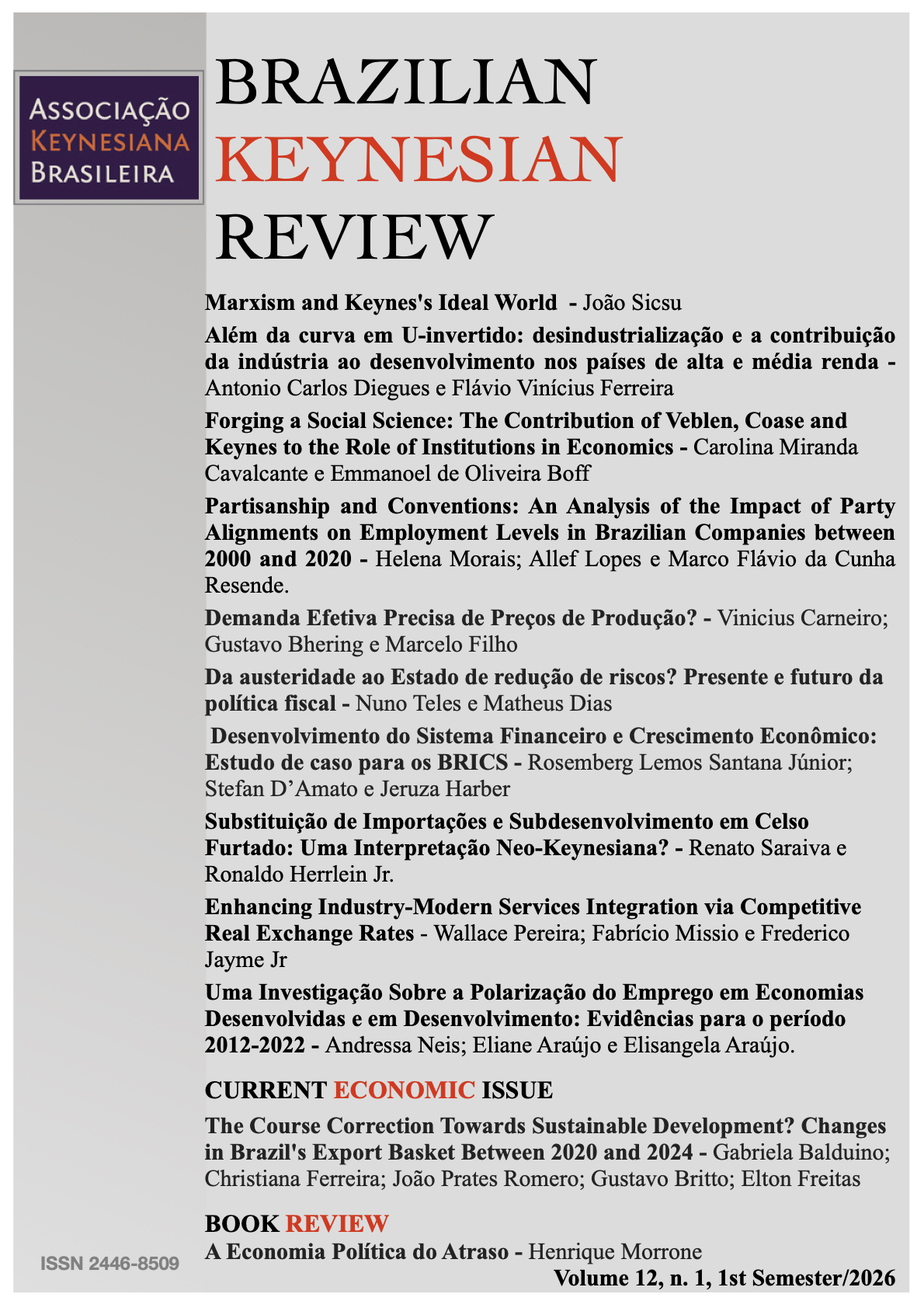
The Course Correction Towards Sustainable Development? Changes in Brazil's Export Basket Between 2020 and 2024
DOI:
https://doi.org/10.33834/bkr.v12i1.423Keywords:
Economic Complexity, Commodities, Industrial Policy, Technology, SustainabilityAbstract
O estudo analisa mudanças na pauta exportadora brasileira entre 2020 e 2024, com base na classificação de Lall (2000) e dados do UN Comtrade e Comex Stat. Nos primeiros anos do governo Lula, houve queda nas exportações de madeira bruta (–67%) e ouro (–55%), revertendo a tendência do período anterior. O número de setores competitivos caiu de 155 para 148, mas os segmentos de média e alta tecnologia cresceram 27,8% e 25%, respectivamente. Esses resultados indicam sinais iniciais de inflexão, associados à retomada de políticas industriais e ao fortalecimento do papel estatal. No entanto, em 2024, produtos primários e baseados em recursos naturais ainda representavam mais de 70% das exportações. O Brasil não avançou no ranking de complexidade econômica, o que indica que a transformação foi limitada. A diversificação segue incipiente, diante de restrições fiscais, fragilidades institucionais e da necessidade de reconstrução da capacidade nacional de planejamento econômico.
Downloads
References
Baumann, R. (2022). Globalização, desglobalização e o Brasil. Brazilian Journal of Political Economy, 42(3), 592–618.
Brasil. Agência Nacional de Mineração. (2024). Informe mineral 2024 – 3º trimestre. https://www.gov.br/anm/pt-br/assuntos/economia-mineral/publicacoes/informe-mineral/publicacoes-nacionais/informe-mineral-2024-3o-trimestre
Brasil. Conselho Nacional de Desenvolvimento Industrial, & Ministério do Desenvolvimento, Indústria, Comércio e Serviços. (2025). Nova indústria Brasil – forte, transformadora e sustentável: Plano de ação para a neoindustrialização 2024–2026 (1ª ed. rev. e atual.). https://www.gov.br/mdic/pt-br/composicao/se/cndi/plano-de-acao/nova-industria-brasil-plano-de-acao-2024-2026-1.pdf
Britto, G., Romero, J. P., Freitas, E., & Coelho, C. (2019). The great divide: Economic complexity and development paths in Brazil and the Republic of Korea. CEPAL Review, 129, 113–131.
Can, M., & Gozgor, G. (2017). The impact of economic complexity on carbon emissions: Evidence from France. Environmental Science and Pollution Research, 24(19), 16364–16370. DOI: 10.1007/s11356-017-9219-7
Confederação Nacional da Indústria. (2023). Desempenho da indústria no mundo (Vol. 7, No. 1). https://static.portaldaindustria.com.br/media/filer_public/34/0f/340fd657-d4e9-43a0-aabc-a7b6bf96b26f/desempenho_da_industria_no_mundo_novembro2023_v2.pdf
De Negri, J. A., & Kubota, L. C. (2008). Políticas de incentivo à inovação tecnológica no Brasil. Instituto de Pesquisa Econômica Aplicada.
Gramkow, C. (2019). O Big Push ambiental no Brasil (Série Perspectivas, No. 20). Fundação Friedrich Ebert Stiftung.
Hartmann, D., Guevara, M. R., Jara-Figueroa, C., Aristarán, M., & Hidalgo, C. A. (2017). Linking economic complexity, institutions, and income inequality. World Development, 93, 75–93. DOI: 10.1016/j.worlddev.2016.12.020
Hausmann, R., & Rodrik, D. (2003). Economic development as self-discovery. Journal of Development Economics, 72(2), 603–633. DOI: 10.1016/S0304-3878(03)00124-X
Hausmann, R., Hidalgo, C. A., Bustos, S., Coscia, M., Chung, S., Jimenez, J., Simoes, A., & Yildirim, M. A. (2014). The atlas of economic complexity: Mapping paths to prosperity (2nd ed.). MIT Press.
Hidalgo, C. A., Klinger, B., Barabási, A. L., & Hausmann, R. (2007). The product space conditions the development of nations. Science, 317(5837), 482–487. DOI: 10.1126/science.1144581
Lall, S. (2000). The technological structure and performance of developing country manufactured exports, 1985–1998. Oxford Development Studies, 28(3), 337–369. DOI: 10.1080/713688318
Mazzucato, M. (2021). Mission economy: A moonshot guide to changing capitalism. Penguin.
Mealy, P., & Teytelboym, A. (2020). Economic complexity and the green economy. Research Policy, 49(8), Article 103948. DOI: /10.1016/j.respol.2020.103948
Neagu, O. (2019). The link between economic complexity and carbon emissions in the European Union countries: A model based on the environmental Kuznets curve approach. Sustainability, 11(17), Article 4753. DOI: 10.3390/su11174753
Observatory of Economic Complexity. (n.d.). Complexity rankings. https://oec.world/
Rodrik, D. (2004). Industrial policy for the twenty-first century (SSRN Working Paper No. 617544). DOI: 10.2139/ssrn.617544
Romero, J. P., & Gramkow, C. (2021). Economic complexity and greenhouse gas emissions. World Development, 139, Article 105317. DOI: 10.1016/j.worlddev.2020.105317
Romero, J. P., Freitas, E., Silveira, F., Britto, G., Cimini, F., & Jayme Jr., F. G. (2024). Complexity-based diversification strategies: A new method for ranking promising activities for regional diversification. Spatial Economic Analysis, 19(4), 1–24. DOI: 10.1080/17421772.2024.2316624
Romero, J. P., Carvalho, D. E., Queiroz, A., & Moura, C. (2021). Mudanças no padrão de exportações brasileiras entre 2016–2020: O Brasil na contramão do mundo (Nota Técnica No. 01/2021). Grupo de Pesquisa em Padrões de Desenvolvimento.
Silveira, F., Romero, J. P., Queiroz, A. R., Freitas, E., & Stein, A. (2025). Economic complexity and deforestation in the Brazilian Amazon. World Development, 185, Article 106804. DOI: 10.1016/j.worlddev.2024.106804
United Nations Comtrade Database. (n.d.). UN Comtrade database. https://comtrade.un.org/
Downloads
Published
How to Cite
Issue
Section
License
Copyright (c) 2026 Gabriela Balduino, Christiana Ferreira, João Prates Romero, Gustavo Britto, Elton Freitas

This work is licensed under a Creative Commons Attribution 4.0 International License.
- Authors keep copyrights and concede to the Journal the right to the first publication, with the paper simultaneously licenced under the Creative Commons Attribution 4.0 International License which allows recognised author and journal work sharing.
- Authors are authorized to assume additional contracts separately, for non-exclusive versions of the paper published in this journal (e.g.: publish in an instituional repository or as a book chapter) with the recogntion of authorship and initial publication in this journal.
- Authors are allowed (and are estimulated) to publish and distribute their work online (e.g.: in institutional repositories or at their personal websites) at any point before or during the editorial process, once this may generate productive alterations on the paper, as well as increse the factor of impact and quotation of the published paper (please, see Free Access Effect)