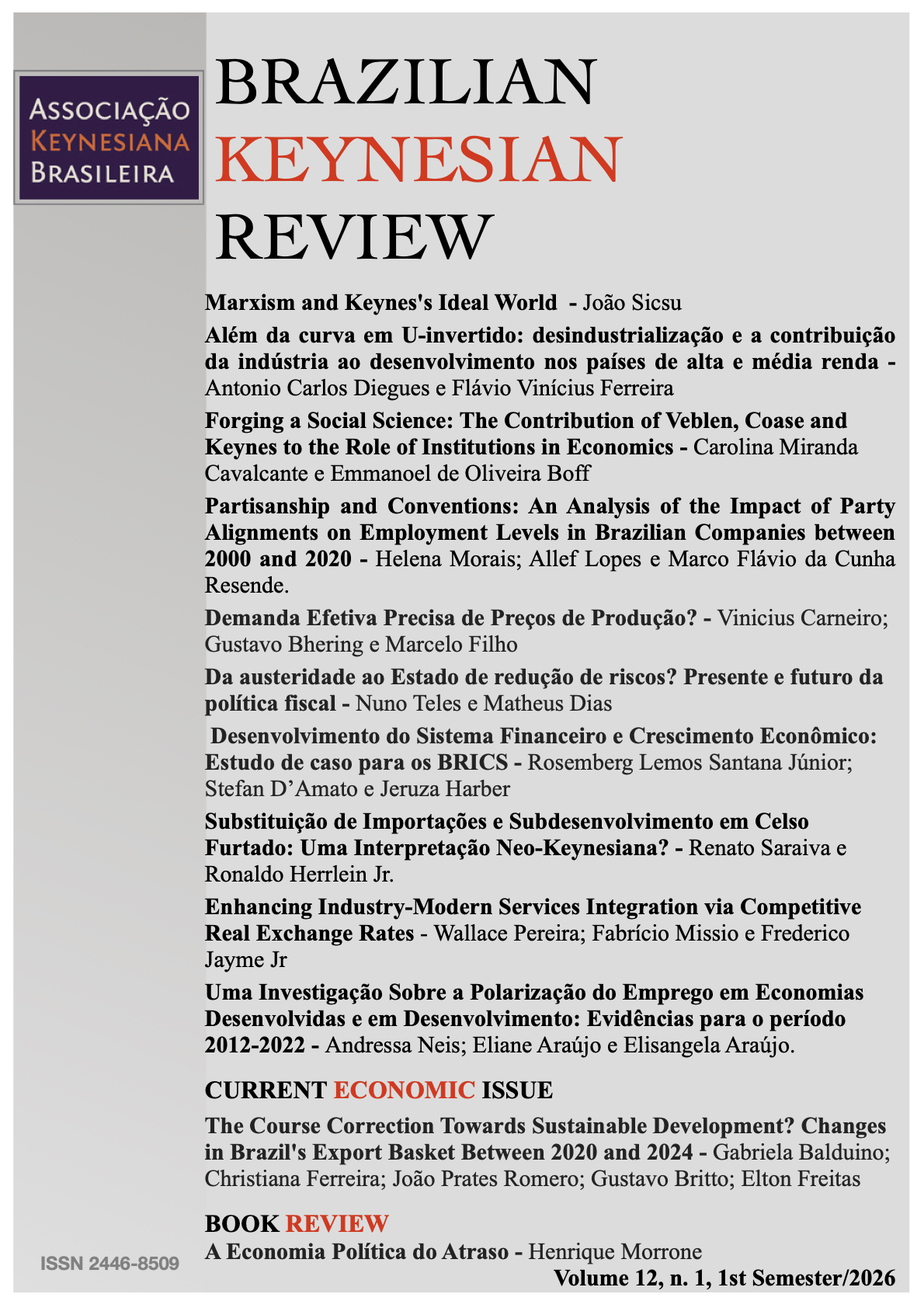
O Ajuste de Rota Rumo ao Desenvolvimento Sustentável? Mudanças na Pauta de Exportações Brasileiras entre 2020 e 2024
DOI:
https://doi.org/10.33834/bkr.v12i1.423Palavras-chave:
Complexidade Econômica, Commodities, Política Industrial, Tecnologia, SustentabilidadeResumo
The study analyzes changes in Brazil’s export structure between 2020 and 2024, based on Lall’s (2000) sectoral classification and data from UN Comtrade and Comex Stat. In the early years of the Lula administration, exports of raw wood and gold declined by 67% and 55%, respectively, reversing the trend observed in the previous period. The number of competitive sectors fell from 155 to 148, but medium- and high-tech segments grew by 27.8% and 25%, respectively. These results indicate initial signs of inflection, linked to the revival of industrial policies and the strengthening of the state’s role. However, in 2024, primary and resource-based products still accounted for over 70% of exports. Brazil did not move up in the economic complexity ranking, suggesting that the transformation was limited. Diversification remains incipient, constrained by fiscal restrictions, institutional weaknesses, and the need to rebuild national capacity for economic planning.
Downloads
Referências
Baumann, R. (2022). Globalização, desglobalização e o Brasil. Brazilian Journal of Political Economy, 42(3), 592–618.
Brasil. Agência Nacional de Mineração. (2024). Informe mineral 2024 – 3º trimestre. https://www.gov.br/anm/pt-br/assuntos/economia-mineral/publicacoes/informe-mineral/publicacoes-nacionais/informe-mineral-2024-3o-trimestre
Brasil. Conselho Nacional de Desenvolvimento Industrial, & Ministério do Desenvolvimento, Indústria, Comércio e Serviços. (2025). Nova indústria Brasil – forte, transformadora e sustentável: Plano de ação para a neoindustrialização 2024–2026 (1ª ed. rev. e atual.). https://www.gov.br/mdic/pt-br/composicao/se/cndi/plano-de-acao/nova-industria-brasil-plano-de-acao-2024-2026-1.pdf
Britto, G., Romero, J. P., Freitas, E., & Coelho, C. (2019). The great divide: Economic complexity and development paths in Brazil and the Republic of Korea. CEPAL Review, 129, 113–131.
Can, M., & Gozgor, G. (2017). The impact of economic complexity on carbon emissions: Evidence from France. Environmental Science and Pollution Research, 24(19), 16364–16370. DOI: 10.1007/s11356-017-9219-7
Confederação Nacional da Indústria. (2023). Desempenho da indústria no mundo (Vol. 7, No. 1). https://static.portaldaindustria.com.br/media/filer_public/34/0f/340fd657-d4e9-43a0-aabc-a7b6bf96b26f/desempenho_da_industria_no_mundo_novembro2023_v2.pdf
De Negri, J. A., & Kubota, L. C. (2008). Políticas de incentivo à inovação tecnológica no Brasil. Instituto de Pesquisa Econômica Aplicada.
Gramkow, C. (2019). O Big Push ambiental no Brasil (Série Perspectivas, No. 20). Fundação Friedrich Ebert Stiftung.
Hartmann, D., Guevara, M. R., Jara-Figueroa, C., Aristarán, M., & Hidalgo, C. A. (2017). Linking economic complexity, institutions, and income inequality. World Development, 93, 75–93. DOI: 10.1016/j.worlddev.2016.12.020
Hausmann, R., & Rodrik, D. (2003). Economic development as self-discovery. Journal of Development Economics, 72(2), 603–633. DOI: 10.1016/S0304-3878(03)00124-X
Hausmann, R., Hidalgo, C. A., Bustos, S., Coscia, M., Chung, S., Jimenez, J., Simoes, A., & Yildirim, M. A. (2014). The atlas of economic complexity: Mapping paths to prosperity (2nd ed.). MIT Press.
Hidalgo, C. A., Klinger, B., Barabási, A. L., & Hausmann, R. (2007). The product space conditions the development of nations. Science, 317(5837), 482–487. DOI: 10.1126/science.1144581
Lall, S. (2000). The technological structure and performance of developing country manufactured exports, 1985–1998. Oxford Development Studies, 28(3), 337–369. DOI: 10.1080/713688318
Mazzucato, M. (2021). Mission economy: A moonshot guide to changing capitalism. Penguin.
Mealy, P., & Teytelboym, A. (2020). Economic complexity and the green economy. Research Policy, 49(8), Article 103948. DOI: /10.1016/j.respol.2020.103948
Neagu, O. (2019). The link between economic complexity and carbon emissions in the European Union countries: A model based on the environmental Kuznets curve approach. Sustainability, 11(17), Article 4753. DOI: 10.3390/su11174753
Observatory of Economic Complexity. (n.d.). Complexity rankings. https://oec.world/
Rodrik, D. (2004). Industrial policy for the twenty-first century (SSRN Working Paper No. 617544). DOI: 10.2139/ssrn.617544
Romero, J. P., & Gramkow, C. (2021). Economic complexity and greenhouse gas emissions. World Development, 139, Article 105317. DOI: 10.1016/j.worlddev.2020.105317
Romero, J. P., Freitas, E., Silveira, F., Britto, G., Cimini, F., & Jayme Jr., F. G. (2024). Complexity-based diversification strategies: A new method for ranking promising activities for regional diversification. Spatial Economic Analysis, 19(4), 1–24. DOI: 10.1080/17421772.2024.2316624
Romero, J. P., Carvalho, D. E., Queiroz, A., & Moura, C. (2021). Mudanças no padrão de exportações brasileiras entre 2016–2020: O Brasil na contramão do mundo (Nota Técnica No. 01/2021). Grupo de Pesquisa em Padrões de Desenvolvimento.
Silveira, F., Romero, J. P., Queiroz, A. R., Freitas, E., & Stein, A. (2025). Economic complexity and deforestation in the Brazilian Amazon. World Development, 185, Article 106804. DOI: 10.1016/j.worlddev.2024.106804
United Nations Comtrade Database. (n.d.). UN Comtrade database. https://comtrade.un.org/
Downloads
Publicado
Como Citar
Edição
Seção
Licença
Copyright (c) 2026 Gabriela Balduino, Christiana Ferreira, João Prates Romero, Gustavo Britto, Elton Freitas

Este trabalho está licenciado sob uma licença Creative Commons Attribution 4.0 International License.
- Autores mantém os direitos autorais e concedem à revista o direito de primeira publicação, com o trabalho simultaneamente licenciado sob a Licença Creative Commons Attribution que permite o compartilhamento do trabalho com reconhecimento da autoria e publicação inicial nesta revista.
- Autores têm autorização para assumir contratos adicionais separadamente, para distribuição não-exclusiva da versão do trabalho publicada nesta revista (ex.: publicar em repositório institucional ou como capítulo de livro), com reconhecimento de autoria e publicação inicial nesta revista.
- Autores têm permissão e são estimulados a publicar e distribuir seu trabalho online (ex.: em repositórios institucionais ou na sua página pessoal) a qualquer ponto antes ou durante o processo editorial, já que isso pode gerar alterações produtivas, bem como aumentar o impacto e a citação do trabalho publicado (Veja O Efeito do Acesso Livre).