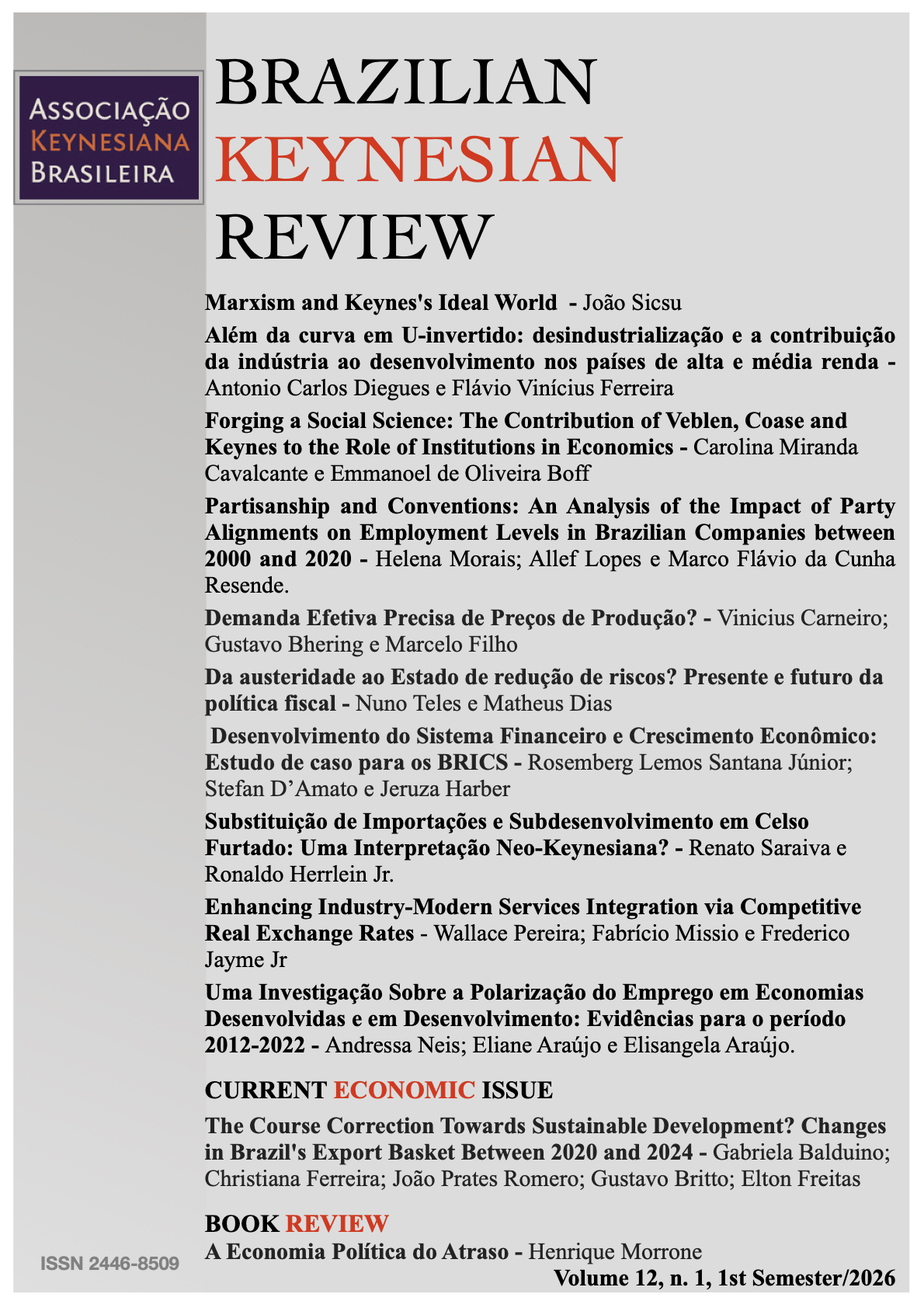
Da austeridade ao Estado de redução de riscos?
Presente e futuro da política fiscal
DOI:
https://doi.org/10.33834/bkr.v12i1.390Keywords:
Fiscal policy, Austerity, Derisking State, New Consensus Macroeconomics, Private-public partnershipAbstract
Abstract
The last three decades have seen the increasing imposition of fiscal rules to reduce public spending. These political measures are theoretically supported by the "New Macroeconomic Consensus," which synthesizes the contributions of monetarism, new classical economics, and new Keynesian economics. With the establishment of a permanent restrictive fiscal policy, public investment was replaced by new financing models, primarily in the form of Public-Private Partnerships (PPP). The current resurgence of industrial policy is often understood as the end of the austerity era. This article argues otherwise. By comparing the trajectories of fiscal policy between the EU, a pioneer in adopting fiscal rules, and Brazil, where these rules have been more stringent, it is asserted that we are currently witnessing a new model of selective fiscal austerity, willing to spend in sectors deemed strategic, from energy to defense. The state reinforces its role in derisking capital, whether through subsidies and financial guarantees in the EU, or through more robust risk reduction measures via a renewed commitment to Public-Private Partnerships, in Brazil. Despite its contradictions, neoliberal fiscal policy succeeded in reinventing itself.
Downloads
References
ALBEROLA, E. et al. (2021) “Fiscal response to the COVID‐19 crisis in advanced and emerging market economies”, Pacific Economic Review, 26(4), p. 459-468. DOI: https://doi.org/10.1111/1468-0106.12370
ARESTIS, P.; SAWYER, M. C. (2003) “New Consensus New Keynesianism, and the Economics of the Third Way”, Levy Economics Institute Working Paper No. 364. Disponível em: https://www.levyinstitute.org/pubs/wp_364.pdf
BAHIA. (2023) “Novo PAC do Governo Federal vai investir R$ 119,4 bilhões em obras na Bahia; governador participou do lançamento”, Disponível em: <https://www.ba.gov.br/casacivil/noticia/2024-05/2091/novo-pac-do-governo-federal-vai-investir-r-1194-bilhoes-em-obras-na-bahia>. Acesso em: 19 jun. 2024.
BILBIIE, F.; MONACELLI, T.; PEROTTI, R. (2021) “Fiscal Policy in Europe: Controversies over Rules, Mutual Insurance, and Centralization”, Journal of Economic Perspectives, 35(2), p. 77–100. DOI: 10.1257/jep.35.2.77
BLANCHARD, O. J.; SUMMERS, L. H. (1986) “Hysteresis and the European Unemployment Problem”, In: Fischer, S. (Eds NBER Macroeconomics Annual 1986. Boston: MIT Press.
BRASIL. (2023) “Tesouro anuncia quatro medidas de incentivo a Parcerias Público-Privadas (PPP),”Disponível em: <https://www.gov.br/tesouronacional/pt-br/noticias/tesouro-anuncia-quatro-medidas-de-incentivo-a-parcerias-publico-privadas-ppp>. Acesso em: 3 de novembro de 2024
BUCHANAN, J. (1984) “Politics without Romance: A Sketch of Positive Public Choice Theory and its Normative Implications”, In: BUCHANAN, J.; TOLLISON, R. (Eds.). The Theory of Public Choice - II. Ann Arbor: University of Michigan Press.
BUDINA, N. et al. (2012) “Fiscal Rules at a Glance: Country Details from a New Dataset”. IMF Working Papers, 12(273) p. 1. Disponível em: <https://www.imf.org/external/pubs/ft/wp/2012/wp12273.pdf> Acesso em: 5 de outubro de 2024
CHrISTOPHERS, B. (2023) Our Lives in Their Portfolios. London: Verso Books.
COOPER, M. (2024) Counterrevolution: Extravagance and Austerity in Public Finance. New York: Zone Books.
THE INFRASCOPE (2022) “The 2021/2022 Infrascope: Country Summaries”. Disponível em: <https://impact.economist.com/projects/infrascope/evaluating-the-environment-for-public-private-partnerships-in-latin-america-and-the-caribbean/>. Acesso em: 20 de junho de 2024.
EUROPEAN COMMISSION (2024) “Recovery and Resilience Facility” Disponível em: <https://commission.europa.eu/business-economy-euro/economic-recovery/recovery-and-resilience-facility_en >. Acesso em: 11 junho de 2024.
EYRAUD, L, XAVIER, D, HODGE, A., LLEDÓ, V. E PATTILLO, C. (2018) “Second-Generation Fiscal Rules: Balancing Simplicity, Flexibility, and Enforceability”, Staff Discussion Notes, 18(04), p. 1. Disponível em: <https://www.imf.org/external/datamapper/fiscalrules/sdn1804-on-second-generation-fiscal-rules.pdf> Acesso em: 5 de outubro de 2024
FINE, B.; DIMAKOU. (2016) Macroeconomics: a critical companion. London: Pluto Press.
FRIEDMAN, M. e HELLER, W. W. (1969) Monetary vs. fiscal policy. New York: W. W. Norton.
FRIEDMAN, M. (1989). “Quantity Theory of Money”. In: Eatwell, J., Milgate, M., Newman, P. (eds) Money (The New Palgrave). London: Palgrave Macmillan DOI: https://doi.org/10.1007/978-1-349-19804-7_1
GABOR, D. (2023), “The (European) Derisking State”. SocArXiv Papers. DOI:10.31235/osf.io/hpbj2
GABOR, D. (2021) “The Wall Street Consensus”, Development and Change, 52(3), p. 429–459. DOI: https://doi.org/10.1111/dech.12645
GABOR, D. e SYLLA N. S. (2023) “Derisking Developmentalism: A Tale of Green Hydrogen”, Development and Change, 54(5), p. 1169-1196. DOI: https://doi.org/10.1111/dech.12779
GOBETTI, S. (2023) “Ajuste fiscal e os limites do possível, novamente”, FGV IBRE. Disponível em: <https://blogdoibre.fgv.br/posts/ajuste-fiscal-e-os-limites-do-possivel-novamente>. Acesso em: 21 de julho de 2024
TOOZE, A. (2019) Crashed: how a decade of financial crises changed the world. New York: Penguin Books.
KEDWARD, K.; GABOR, D.; RYAN-COLLINS, J. (2022) “Aligning finance with the green transition: From a risk-based to an allocative green credit policy regime”. UCL Institute for Innovation and Public Purpose, Working Paper Series 2022/11. DOI: https://dx.doi.org/10.2139/ssrn.4198146
KYDLAND, F. E. e PRESCOTT, E. C. (1977) “Rules Rather than Discretion: The Inconsistency of Optimal Plans”, Journal of Political Economy, 85(3), p. 473–491. Disponível em: <https://www.jstor.org/stable/1830193> . Acesso em: 5 de outubro de 2024
LAVOIE, M. (2015) Post-Keynesian Economics: New Foundations. Cheltenham: Edward Elgar Publishing.
LOPREATO, F. L. C. (2013) “Milton Friedman e a efetividade da política fiscal”, Revista de Economia Contemporânea, 17(2), p. 201–220. DOI: https://doi.org/10.1590/S1415-98482013000200001
LOPREATO, F. (2022) “Regras fiscais: o olhar internacional e a experiência brasileira”, Texto para Discussão n. 426. Disponível em: <https://www.eco.unicamp.br/images/arquivos/artigos/TD/TD426.pdf> Acesso em: 5 de outubro de 2024
LUCAS JR., R. E. e SARGENT, T. J. (1979) “After Keynesian Macroeconomics”, Quarterly Review, v. 3(2).
LUCAS, R. E. (1972) “Expectations and the neutrality of money”. Journal of Economic Theory, v. 4(2), p. 103–124. DOI: https://doi.org/10.1016/0022-0531(72)90142-1
MASTERS , B. e GARA, A. (2014) “BlackRock to buy Global Infrastructure Partners for $12.5bn” Disponível em: <https://www.ft.com/content/a0901489-6caa-42b8-ac55-1a09e64ef927>. Acesso em: 11 de junho de 2024.
DAVOODI H, ELGER, P. FOTIOU, A. GARCIA-MACIA, D. HAN, X. LAGERBORG, A. LAM, R. e MEDAS, P. (2022) “Fiscal Rules and Fiscal Councils: Recent Trends and Performance during the COVID-19 Pandemic”, IMF Working Papers, 11, p. 1.
MIROWSKI, P. e PLEHWE, D.. (2009) The road from Mont Pèlerin: the making of the neoliberal thought collective, Cambridge, Mass.: Harvard University Press.
NATIONAL AUDIT OFFICE. (2009) “PFI and PF2”. Disponível em: <https://www.nao.org.uk/reports/pfi-and-pf2/>. Acesso em: 11 jun. 2024.
O’NEILL, P. (2009) “Infrastructure Investment and the Management of Risk”. In: CLARK, G. L.; DIXON, A. D.; MONK, A. H. B. (Eds.) Managing Financial Risks: From Global to Local, Oxford: Oxford University Press.
OTTA, L. AIKO. (2023) “Passado de erros lança sombra da dúvida sobre o programa”, Disponível em: <https://valor.globo.com/brasil/noticia/2023/08/14/passado-de-erros-lanca-sombra-da-duvida-sobre-o-programa.ghtml>. Acesso em: 19 jun. 2024.
RODRIGUES, J. (2022) O Neoliberalismo não é um Slogan. Lisboa: Tinta da China.
SARMENTO, M. e RENNEBOOG, L. (2017) “Anatomia das Parcerias Público Privadas : A sua criação, financiamento e renegociações”, Disponível em: <https://julgar.pt/anatomia-das-parcerias-publico-privadas-a-sua-criacao-financiamento-e-renegociacoes/> Acesso em: 3 de novembro de 2024.
SCHUBERTH, H. (2024) “The European Union’s New Risk-Based Framework for Fiscal Rules – Overly Complex, Opaque and Self-Defeating.” Disponível em: <https://www.ineteconomics.org/perspectives/blog/fiscal-reform-in-the-eu-a-dangerous-new-framework>. Acesso em: 11 jun. 2024.
SCLAR, E. (2014) “The political economics of investment Utopia: public–private partnerships for urban infrastructure finance” Journal of Economic Policy Reform, 18(1), p. 1–15. DOI: https://doi.org/10.1080/17487870.2014.950857
SKIDELSKY, R. (2018) Money and government : the past and future of economics. New Haven: Yale University Press.
STIGLITZ, J. E. e WEISS, A. (1981) “Credit Rationing in Markets with Imperfect Information”. The American Economic Review, 71(3), p. 393–410. Disponível em: <https://www.jstor.org/stable/1802787> . Acesso em: 5 de outubro de 2024
STREECK, W. (2017) The rise of the European consolidation state. In: MAGARA, H. (Ed.). Policy Change under New Democratic Capitalism. London: Routledge.
TAVARES, M. (2005) “Vinte anos de política fiscal no Brasil: dos fundamentos do novo regime à Lei de Responsabilidade Fiscal”. Revista de Economia & Relações Internacionais, 4(7), p. 79–101.
TELES, N. (2022) “Pandemia, crise económica e o novo papel do Estado”. Revista Crítica de Ciências Sociais, n. 128, p. 15–38. DOI: https://doi.org/10.4000/rccs.13429
THE WHITE HOUSE. (2022) “Building A Clean Energy Economy: A Guidebook To The Inflation Reduction Act’s Investments In Clean Energy And Climate Action”. Disponível em: <https://www.whitehouse.gov/wp-content/uploads/2022/12/Inflation-Reduction-Act-Guidebook.pdf>. Acesso em: 3 de novembro de 2024
TRIBUNAL DE CONTAS EUROPEU. (2018) “Parcerias Público Privadas na UE: insuficiências generalizadas e benefícios limitados”. Disponível em: <https://www.eca.europa.eu/pt/publications?did=45153>. Acesso em: 11 jun. 2024.
WORLD BANK GROUP. (2017) “Maximizing Finance for Development (MFD)” Disponível em: <https://documents.worldbank.org/en/publication/documents-reports/documentdetail/168331522826993264/maximizing-finance-for-development-mfd>. Acesso em: 11 de junho de 2024.
Downloads
Published
How to Cite
Issue
Section
License
Copyright (c) 2026 Nuno Teles, Matheus Dias

This work is licensed under a Creative Commons Attribution 4.0 International License.
- Authors keep copyrights and concede to the Journal the right to the first publication, with the paper simultaneously licenced under the Creative Commons Attribution 4.0 International License which allows recognised author and journal work sharing.
- Authors are authorized to assume additional contracts separately, for non-exclusive versions of the paper published in this journal (e.g.: publish in an instituional repository or as a book chapter) with the recogntion of authorship and initial publication in this journal.
- Authors are allowed (and are estimulated) to publish and distribute their work online (e.g.: in institutional repositories or at their personal websites) at any point before or during the editorial process, once this may generate productive alterations on the paper, as well as increse the factor of impact and quotation of the published paper (please, see Free Access Effect)