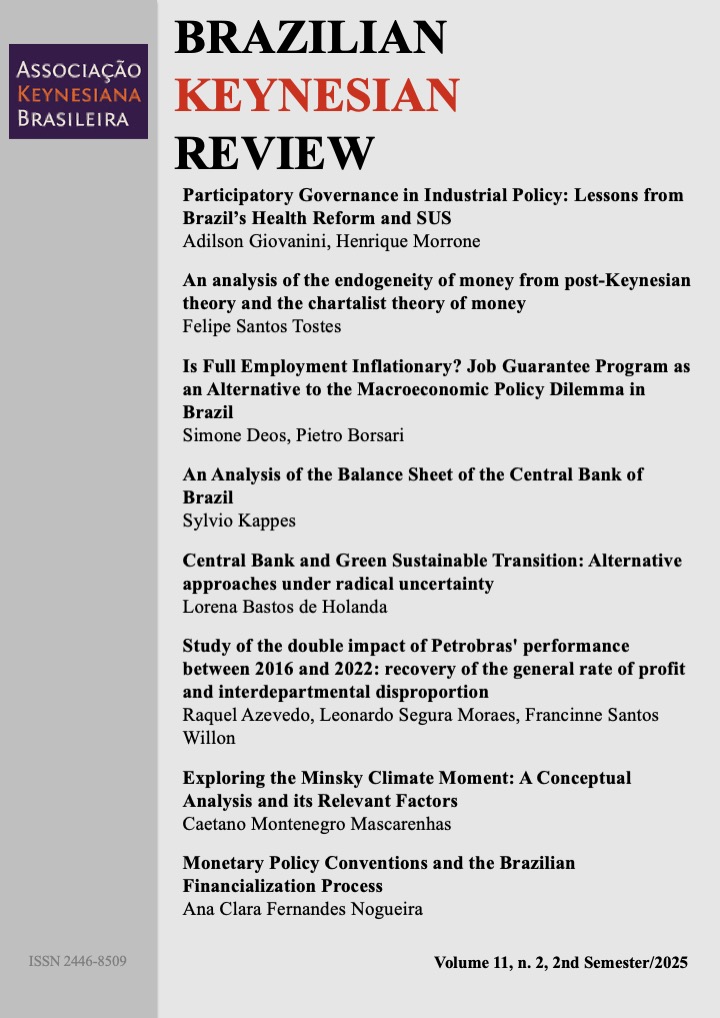
Explorando o Momento Minsky Climático:
Uma Análise Conceitual e seus Fatores
DOI:
https://doi.org/10.33834/bkr.v11i2.395Palavras-chave:
Crise Climática, Momento Minsky, Transição Climática, Instabilidade Financeira, Economia PolíticaResumo
O termo Momento Minsky Climático foi inicialmente introduzido por Carney (2015) como uma extensão do tradicional Momento Minsky, representando um paradigma emergente nas discussões sobre os riscos financeiros associados às mudanças climáticas. Apesar de sua crescente relevância, o conceito e os principais fatores que moldam esse fenômeno ainda permanecem pouco explorados. Este artigo aborda essa lacuna por meio de uma análise conceitual e teórica do Momento Minsky Climático. São examinadas as bases teóricas do conceito, com ênfase em suas implicações para a estabilidade financeira e ambiental, bem como sua importância no atual contexto de crise climática. Além disso, analisam-se os principais fatores que contribuem para a formação do Momento Minsky Climático, incluindo a exposição de ativos relacionados ao clima e as respostas de investidores e reguladores. Esse debate fornece subsídios para análises mais aprofundadas e para a avaliação da pertinência do conceito diante das dinâmicas das mudanças climáticas.
Downloads
Referências
Banco Central do Brasil. (2019). Mensuração de riscos para a inflação associados a preços de energia (Estudo Especial nº 61/2019).
Bartelega, C. F. (2023). A atuação do BNDES na economia verde de 2010 a 2021 (Dissertação de mestrado, Instituto de Economia, Universidade Estadual de Campinas). Universidade Estadual de Campinas.
Bendixen, W. (2022). A climate Minsky moment in a stock-flow consistent model (SOAS Department of Economics Student Working Paper No. 06). London: SOAS University of London.
Bhattacharya, S., Goodhart, C., Tsomocos, D. P., & Vardoulakis, A. (2011). Minsky’s financial instability hypothesis and the leverage cycle (London School of Economics FMG Special Paper). DOI: 10.2139/ssrn.1773946
Bovari, E., Giraud, G., & Mc Isaac, F. (2018). Coping with collapse: A stock-flow consistent monetary macrodynamics of global warming. Ecological Economics, 147, 383–398. DOI: 10.1016/j.ecolecon.2018.01.034
Breeden, S., & Hauser, A. (2019). A climate Minsky moment. In Global Public Investor Report. Official Monetary and Financial Institutions Forum.
Caldecott, B., Harnett, E., Cojoianu, T., Kok, I., & Pfeiffer, A. (2016). Stranded assets: A climate risk challenge. DOI: 10.18235/0012646
Campiglio, E., Dafermos, Y., Monnin, P., Ryan-Collins, J., Schotten, G., & Tanaka, M. (2022). Climate‐related risks in financial assets. Journal of Economic Surveys, 37(3), 950–DOI: 10.1111/joes.12525
Carney, M. (2015). Breaking the tragedy of the horizon–climate change and financial stability. Speech given at Lloyd’s of London, 29, p. 220-230.
Caverzasi, E. (2014). Minsky and the subprime mortgage crisis: The financial instability hypothesis in the era of financialization. Levy Economics Institute, Working Paper, (796). DOI: 10.2139/ssrn.2430259
Christophers, B. (2017). Climate change and financial instability: Risk disclosure and the problematics of neoliberal governance. Annals of the American Association of Geographers, 107(5), 1108-1127. DOI: 10.1080/24694452.2017.1293502
Crocco, M. A., & Feil, F. (2019). Um ensaio sobre riscos ambientais e estabilidade do sistema financeiro: O caso do Brasil no pós pandemia. In S. Bercovici, J. Sicsú, & L. Aguiar (Orgs.), Utopias para reconstruir o Brasil. Editora Quartier Latin.
Culhane, T., Hall, G., & Roberts, J. T. (2021). Who delays climate action? Interest groups and coalitions in state legislative struggles in the United States. Energy Research & Social Science, 79, 102114. DOI: 10.1016/j.erss.2021.102114
Dafermos, Y., Gabor, D., & Michell, J. (2023). Institutional supercycles: An evolutionary macro-finance approach. New Political Economy, 1-20. DOI: 10.1080/13563467.2022.2161497
Dafermos, Y., Nikolaidi, M., & Galanis, G. (2018). Climate change, financial stability and monetary policy. Ecological Economics, 152, 219-234. DOI: 10.1016/j.ecolecon.2018.05.011
Daumas, L. (2023). Financial stability, stranded assets and the low‐carbon transition–A critical review of the theoretical and applied literatures. Journal of Economic Surveys. DOI: 10.1111/joes.12551
De Antoni, E. (2010). Minsky, Keynes, and financial instability: The recent subprime crisis. International Journal of Political Economy, 39(2), 10-25. DOI: 10.2753/IJP0891-1916390202
Gómez-Baggethun, E. (2020). More is more: Scaling political ecology within limits to growth. Political Geography, 76, 102095. DOI: 10.1016/j.polgeo.2019.102095
Hayne, M., Ralite, S., Thomä, J., & Koopman, D. (2019). Factoring transition risks into regulatory stress-tests: The case for a standardized framework for climate stress testing and measuring impact tolerance to abrupt late and sudden economic decarbonization. ACRN Journal of Finance and Risk Perspectives, 8, 206. DOI: 10.35944/jofrp.2019.8.1.013
Intergovernmental Panel on Climate Change (IPCC). (2023). Summary for policymakers. In Climate change 2023: Synthesis report. Contribution of Working Groups I, II and III to the Sixth Assessment Report of the Intergovernmental Panel on Climate Change. Geneva, Switzerland: IPCC.
Kallis, G. (2018). Degrowth. Newcastle upon Tyne: Agenda Publishing.
Kapeller, J., & Schütz, B. (2014). Debt, boom, bust: A theory of Minsky-Veblen cycles. Journal of Post Keynesian Economics, 36(4), p. 781–814. DOI: 10.2753/PKE0160-3477360409
Knell, M. (2015). Schumpeter, Minsky and the financial instability hypothesis. Journal of Evolutionary Economics, 25, p. 293–310. DOI: 10.1007/s00191-014-0370-8
Lamperti, F., Bosetti, V., Roventini, A., & Tavoni, M. (2018). Faraway, so close: Coupled climate and economic dynamics in an agent-based integrated assessment model. Ecological Economics, 150, p. 315–339. DOI: 10.1016/j.ecolecon.2018.03.023
Mehrling, P. (1998). The vision of Hyman P. Minsky. Journal of Economic Behavior & Organization, 39(2), p. 129–158.
Miller, H., & Dikau, S. (2022). Preventing a “climate Minsky moment”: Environmental financial risks and prudential exposure limits. London: Grantham Research Institute on Climate Change, London School of Economics and Political Science.
Minsky, H. (1992). The financial instability hypothesis (Working Paper No. 74). The Jerome Levy Economics Institute of Bard College.
Minsky, H. (2013). The relevance of Kalecki: The useable contribution. PSL Quarterly Review, 67(265), p. 95–106.
Minsky, H. P. (1986). Stabilizing an unstable economy. New Haven: Yale University Press.
Network for Greening the Financial System. (2020). Climate scenarios for central banks and supervisors (NGFS technical document).
Ocampo, J. (2011). The transition to a green economy: Benefits, challenges and risks from a sustainable development perspective. United Nations. Second Preparatory Committee Meeting for United Nations Conference on Sustainable Development.
Palley, T. (2011). A theory of Minsky super-cycles and financial crises. Contributions to Political Economy, 30(1), p. 31–46. DOI: 10.1093/cpe/bzr004
Robbins, P. (2020). Is less more… or is more less? Scaling the political ecologies of the future. Political Geography, 76, 102018. DOI: 10.1016/j.polgeo.2019.04.010
Semieniuk, G., et al. (2021). Low‐carbon transition risks for finance. Wiley Interdisciplinary Reviews: Climate Change, 12(1), e678. DOI: 10.1002/wcc.678
Semieniuk, G., Holden, P. B., Mercure, J.-F., Salas, P., Pollitt, H., Jobson, K., Vercoulen, P., Chewpreecha, U., Edwards, N. R., & Viñuales, J. E. (2022). Stranded fossil-fuel assets translate to major losses for investors in advanced economies. Nature Climate Change, 12(6), p. 532–538. DOI: 10.1038/s41558-022-01356-y
Seto, K. C., Davis, S. J., Mitchell, R. B., Stokes, E. C., Unruh, G., & Ürge-Vorsatz, D. (2016). Carbon lock-in: types, causes, and policy implications. Annual review of environment and resources, 41(1), p. 425-452. DOI: 10.1146/annurev-environ-110615-085934
Stern, D. I. (2011). The role of energy in economic growth. Annals of the New York Academy of Sciences, 1219(1), p. 26–51. DOI: 10.1111/j.1749-6632.2010.05921.x
Torres Filho, E. T. (2020). Minsky: Moeda, restrição de sobrevivência e hierarquia do sistema monetário globalizado. Economia e Sociedade, 29, p. 737–760. DOI: 10.1590/1982-3533.2020v29n3art03
Torres Filho, E. T., & Martins, N. M. (2020). Regulação financeira em Minsky: Restrição de sobrevivência, instabilidade financeira e regulação dinâmica (Texto para Discussão 004). Instituto de Economia, Universidade Federal do Rio de Janeiro.
UNITED NATIONS. Inter-agency Task Force on Financing for Development. Financing for Sustainable Development Report 2023: Financing Sustainable Transformations. New York: United Nations, 2023.
Unruh, G. C. (2000). Understanding carbon lock-in. Energy policy, 28(12), p. 817-830. DOI: 10.1016/S0301-4215(00)00070-7
Vormedal, I., Bjander, J., Larsen, M. L., & Lindberg, M. B. (2023). Technological change and the politics of decarbonization: A re-making of vested interests?. Environmental Innovation and Societal Transitions, 47, 100725. DOI: 10.1016/j.eist.2023.100725
Whalen, C. J. (2008a). A Minsky moment: Reflections on Hyman P. Minsky (1919–1996). Journal of Economic Issues, 42(1), p. 249–253. DOI: 10.1080/00213624.2008.11507125
Whalen, C. J. (2008b). Understanding the credit crunch as a Minsky moment. Challenge, 51(1), p. 91–109. DOI: 10.2753/0577-5132510106
Yellen, J. L. (2009). A Minsky meltdown: Lessons for central bankers. In Annual Hyman P. Minsky Conference on the State of the U.S. and World Economies—“Meeting the Challenges of the Financial Crisis”. Levy Economics Institute of Bard College.
Downloads
Publicado
Como Citar
Edição
Seção
Licença
- Autores mantém os direitos autorais e concedem à revista o direito de primeira publicação, com o trabalho simultaneamente licenciado sob a Licença Creative Commons Attribution que permite o compartilhamento do trabalho com reconhecimento da autoria e publicação inicial nesta revista.
- Autores têm autorização para assumir contratos adicionais separadamente, para distribuição não-exclusiva da versão do trabalho publicada nesta revista (ex.: publicar em repositório institucional ou como capítulo de livro), com reconhecimento de autoria e publicação inicial nesta revista.
- Autores têm permissão e são estimulados a publicar e distribuir seu trabalho online (ex.: em repositórios institucionais ou na sua página pessoal) a qualquer ponto antes ou durante o processo editorial, já que isso pode gerar alterações produtivas, bem como aumentar o impacto e a citação do trabalho publicado (Veja O Efeito do Acesso Livre).