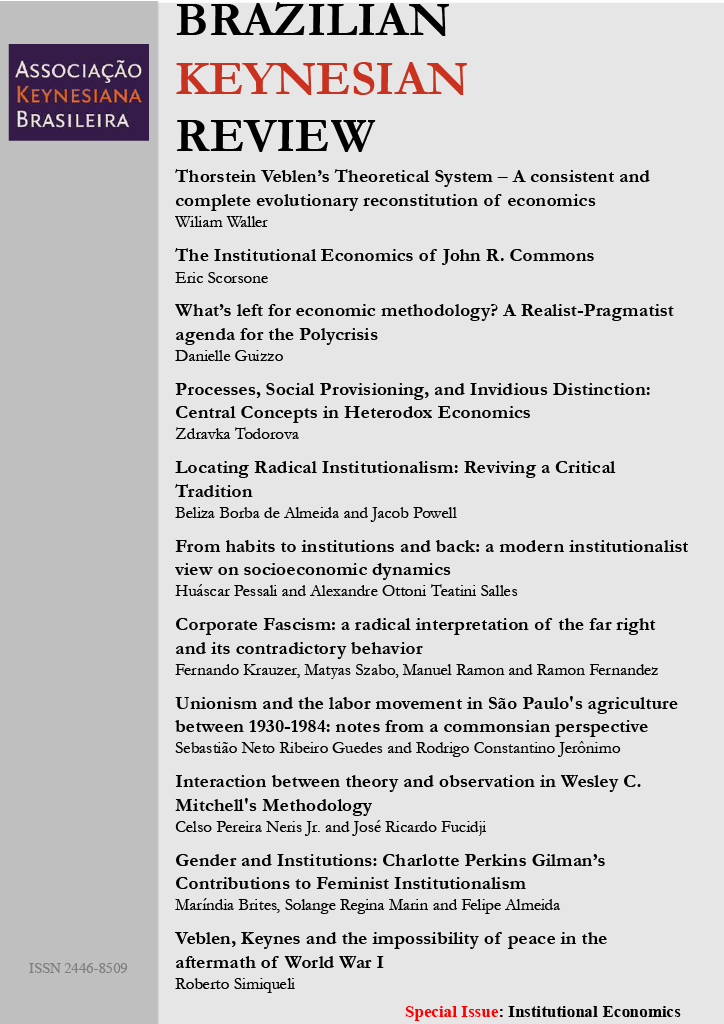
Gender and Institutions: Charlotte Perkins Gilman’s Contributions to Feminist Institutionalism
Palavras-chave:
Charlotte Perkins Gilman, Feminist Institutionalism, Dualisms, History of economic thought and WomenResumo
Charlotte Perkins Gilman (1860–1935) was one of the most influential sociologists, economists, and feminists in the United States at the turn of the nineteenth to the twentieth century. However, until recently, recognition of her contributions as an economist and to feminist institutionalist thought has been limited, failing to reflect the full scope of her work. This article aims to highlight Gilman’s pioneering contributions to Feminist Institutionalism, with particular emphasis on her critiques of gender dualisms. This study addresses three fundamental aspects of her writings: (i) the concept of gender as an institution; (ii) the conception of the “home” as an archaic institution in need of restructuring; and (iii) Gilman’s views on progress and institutional change. By revisiting the significance of her work, this article seeks to challenge the androcentrism prevalent in the discipline and reposition her ideas within the context of feminist-institutionalist thought.
Downloads
Referências
Allen, J. A. (2004). “The Overthrow” of Gynaecocentric Culture: Charlotte Perkins Gilman and Lester Frank Ward. In: C. J. Davis & D. D. Knight (Eds.), Charlotte Perkins Gilman and Her Contemporaries: Literary and Intellectual Contexts. Tuscaloosa: The University of Alabama Press, 59-86.
Almeida, F. & Almeida, B. B. de (2025). Looking for Reasonableness within Twenty-First-Century Neoliberalism: Toward Avoiding the Spread of Fascist Values. Journal of Economic Issues, 59(2), 453–463.
Almeida, B. B. de; & Powell, J. (2026, no prelo) “Locating Radical Institutionalism: Reviving a Critical Tradition”. Brazilian Keynesian Review.
Barker, Drucilla; Kuiper, Edith (2003). Introduction. In: Barker, Drucilla; KUIPER, Edith. Toward a Feminist Philosophy of Economics. London: Routledge, 1-18.
Böck, Ricardo & Almeida, Felipe (2018). Clarence Ayres, Ayresianos e a evolução do institucionalismo Vebleniano. Economia e Sociedade, 27(2), 381-407.
Bush, P. D. (1987). The Theory of Institutional Change. Journal of Economic Issues, 21(3), 1075–1116.
Carver, M. M. (2008). Everyday Women Find Their Voice in the Public Sphere, Journalism History, 34(1), 15–22.
Chang, L.-W. (2010). Economics, Evolution, and Feminism in Charlotte Perkins Gilman’s Utopian Fiction. Women’s Studies, 39(4), 319–348.
Connell, J. M. (1995). Revisiting the Concept of Community: An Examination of Charlotte Perkins Gilman’s Utopian Vision. Peabody Journal of Education, 70(4), 19–33.
Cruea, S. M. (2005). Changing Ideals of Womanhood During the Nineteenth-Century Woman Movement. University Writing Program Faculty Publications. https://scholarworks.bgsu.edu/gsw_pub/1.
Daflon, V. T., & Sorj, B. (2021). Clássicas do Pensamento Social: mulheres e feminismos no século XIX. Rio de Janeiro: Rosa dos Tempos.
Degler, C. (1956). Charlotte Perkins Gilman on the Theory and Practice of Feminism. American Quarterly, 8(1), 21–39.
Diggins, J. P. (1978). The Bard of Savagery: Thorstein Veblen and Modern Social Theory. New York: Seabury Press.
Dimand, M. A. (1995). The economics of Charlotte Perkins Gilman. In: M.A. Dimand, R.W. Dimand & E.L. Forget (Eds.), Women of value. Feminist Essays on the History of Women in Economics, 124-149.
Dimand, M. A. (2000). Charlotte Perkins Gilman. In: R. W. Dimand, M. A. Dimand, & E. L. Forget (Eds.), A Biographical Dictionary of Women. Cheltenham: Edward Elgar Publishing Limited, 174-183.
Dorfman, J. (1934). Thorstein Veblen and His América. Clifton: Augustus M. Kelley Publishers.
Dugger, W. (1980). Power: an institutional framework of analysis. Journal of Economic Issues, 15(4), 897–907.
Dugger, W. (1989). Instituted Process and Enabling Myth: The Two Faces of the Market. Journal of Economic Issues, 23(2), 607-615, 1989.
Eby, C. V. (1992). Veblen’s anti-anti-feminism. Canadian Review of American Studies, 22(Supplement 2), 215–238.
Finlay, B. (1999). Lester Frank Ward as a Sociologist of Gender: A New Look at His Sociological. Gender and Society, 13(2), 251–265.
Flanagan, M. (2007). America Reformed: Progressives and Progressivisms, 1890s–1920s. Oxford: Oxford University Press.
Gilman, C. P. (1898 [2021]). Women and Economics. Westchester: Mint Editions.
Gilman, C. P. (1903). The Home: Its Work and Influence. London: William Heinemann MCMIV.
Gilman, C. P. (1911 [2020]). The Man-Made World; Or, Our Androcentric Culture. Westchester: Mint Editions. https://www.gutenberg.org/cache/epub/3015/pg3015-images.html.
Gilman, C. P. (1915a [2002]). The dress of women: a critical introduction to the symbolism and sociology of clothing (M. R. Hill & M. J. Deegan, Eds.) United States: United Press.
Gilman, C. P. (1915b [2020]). Terradelas. Porto Alegre: TAG.
Gilman, N. (1999). Thorstein Veblen’s Neglected Feminism. Journal of Economic Issues, 33(3): 689–711.
Gil-Vásquez, K., & Elsner, W. (2024). The “triumph of imbecile institutions over life”: Death cults as an enabling myth of late neoliberalism. Journal of Economic Issues, 58(3), 709–731.
Hall, J. B., & Luz, M. R. de S. (2020). Thorstein Veblen as evolutionary feminist economist of the Progressive Era. Journal of Economic Issues 54(2), 413–419.
Hausman, B. L. (1998). Sex before Gender: Charlotte Perkins Gilman and the Evolutionary Paradigm of Utopia. Feminist Studies, 24(3), 488–510.
Hill, M. R. (2011). Introduction: Charlotte Perkins Gilman on the sociology of families, marriages, and children. In C. P. Gilman, Families, marriages, and children (pp. xi–xix). New Brunswick: Transaction Publications.
Jennings, A. (1993). Public or private? Institutional economics and feminism. In M. A. Ferber & J. A. Nelson (Eds.), Beyond Economic Man: Feminist Theory and Economics (pp. 111–129). Chicago and London: The University of Chicago Press.
Jennings, A. (1998). Veblen’s feminism in historical perspective. In W. J. Samuels (Ed.), The Founding of Institutional Economics: The Leisure Class and Sovereignty (pp. 201–233). London and New York: Routledge.
Kuiper, E. (2022). A Herstory of Economics. New York: Wiley.
Lengermann, P. M., & Niebrugge, G. (2019). Charlotte Perkins Gilman (1860-1935). Estructura social y género. In P. M. Lengermann & G. Niebrugge (Eds.), Fundadoras de la Sociología y la Teoría Social 1830-1930 (pp. 187–262). Madrid: Centro de Investigaciones Sociológicas.
Matthews, G. (1987). Just a Housewife: The Rise and Fall of Domesticity in America. New York: Oxford University Press, 35-65.
Matthews, J. V. (2003). The rise of the New Woman: the women’s movement in America, 1875-1930. Chicago: The American Ways Series.
Morgan, M., & Rutherford, M. (1998). American Economics: The Character of the Transformation” History of Political Economy, 30(Supplement), 1–26.
Nelson, J. (1994). Feminism and Economics. In D. M. Hausman (Ed.), The Philosophy of Economics: An Anthology (2nd ed., pp. 454–475). Cambridge: Cambridge University Press.
O’Donnell, M. G. (1994). Early Analysis of the Economics of Family Structure: Charlotte Perkins Gilman’s Women and Economics. Review of Social Economy, LII(2), 86–95.
O’Donnell, M. G. (1996). A Reply to Charlotte Perkins Gilman: Reassessing Her Significance for Feminism and Social Economics. Review of Social Economy LIV(3), 336–340.
Powell, J. (2023) The Instrumentality of Ceremonial Habits of Thought. Journal of Economic Issues, 57(2), 423–431.
Pujol, M. A. (2003). Into the margin! In D. K. Barker & E. Kuiper (Eds.), Toward a Feminist Philosophy of Economics, (pp. 21–37). London: Routledge.
Rensing, S. (2013). Women “waking up” and moving the mountain: The feminist eugenics of Charlotte Perkins Gilman. MP: An Online Feminist Journal, 4(1), 96–120.
Richardson, A., & Willis, C. (2001). Introduction. In A. Richardson & C. Willis (Eds.), The New Woman in fiction and in fact: fin-de-siècle feminisms (pp. 1–38). New York: Palgrave Macmillan.
Rutherford, M. (1984). Thorstein Veblen and the processes of institutional change. History of Political Economy, 16(3), 331–348.
Scott, C. H. (1970). A naturalistic rationale for women’s reform: Lester Frank Ward on the evolution of sexual relations. The Historian, 33(1), p. 54–67.
Sheth, F. A., & Prasch, R. E. (1996). Charlotte Perkins Gilman: Reassessing Her Significance for Feminism and Social Economics. Review of Social Economy, LIV(3), 323–336.
Sinclair, A. (1965). The Better Half: the emancipation of the American Woman. New York: Harper & Row, 269-273.
Van Staveren, I. (2003). Feminist fiction and feminist economics: Charlotte Perkins Gilman on efficiency. In D. K. Barker & E. Kuiper (Eds.), Toward a Feminist Philosophy of Economics (pp. 56–69). London and New York: Routledge.
Vallet, G. (2023). Rebuilding the economy of the home - for the emergence of the “new woman”: Charlotte Perkins Gilman’s pioneering thoughts. The European Journal of the History of Economic Thought, 30(1), 62–85.
Veblen, T. (1894 [2003]). The Economic Theory of Women’s Dress. In S. Mestrovic (Ed.), Thorstein Veblen on Culture and Society (pp. 120–126). London: Sage Publications.
Veblen, T. (1899a [1934]). The Theory of the Leisure Class. New York: The Modern Library.
Veblen, T. (1899b [2003]). The Barbarian Status of Women. In S. Mestrovic (Ed.), Thorstein Veblen on Culture and Society (pp. 111–119). London: Sage Publications.
Veblen, T. (1904 [2009]). The Theory of Business Enterprise. Gloucester: Dodo Press.
Waddoups, J., & Tilman, R. (1992). Thorstein Veblen and the feminism of institutional economists. International Review of Sociology: Revue Internationale de Sociologie, 3(3), 182–204.
Waller, W. (2022). Institutions, technology, and instrumental value: A reassessment of the Veblenian dichotomy. In C. Whalen (Ed.), Institutional economics: Perspectives and methods in pursuit of a better world. London and New York: Routledge, 19-48.
Waller, W., & Jennings, A. (1990). On the possibility of a feminist economics: The convergence of institutional and feminist methodology. Journal of Economic Issues, 24(2), 613–622.
Waller, W., & Jennings, A. (1991). A feminist institutionalist reconsideration of Karl Polanyi. Journal of Economic Issues, 25(2), 485–497.
Waller, W., & Wrenn, M. (2021). Feminist institutionalism and neoliberalism. Feminist Economics, 27(3), 51–76.
Downloads
Publicado
Como Citar
Edição
Seção
Licença
Copyright (c) 2026 Maríndia Brites, Solange Regina Marin, Felipe Almeida

Este trabalho está licenciado sob uma licença Creative Commons Attribution 4.0 International License.
- Autores mantém os direitos autorais e concedem à revista o direito de primeira publicação, com o trabalho simultaneamente licenciado sob a Licença Creative Commons Attribution que permite o compartilhamento do trabalho com reconhecimento da autoria e publicação inicial nesta revista.
- Autores têm autorização para assumir contratos adicionais separadamente, para distribuição não-exclusiva da versão do trabalho publicada nesta revista (ex.: publicar em repositório institucional ou como capítulo de livro), com reconhecimento de autoria e publicação inicial nesta revista.
- Autores têm permissão e são estimulados a publicar e distribuir seu trabalho online (ex.: em repositórios institucionais ou na sua página pessoal) a qualquer ponto antes ou durante o processo editorial, já que isso pode gerar alterações produtivas, bem como aumentar o impacto e a citação do trabalho publicado (Veja O Efeito do Acesso Livre).