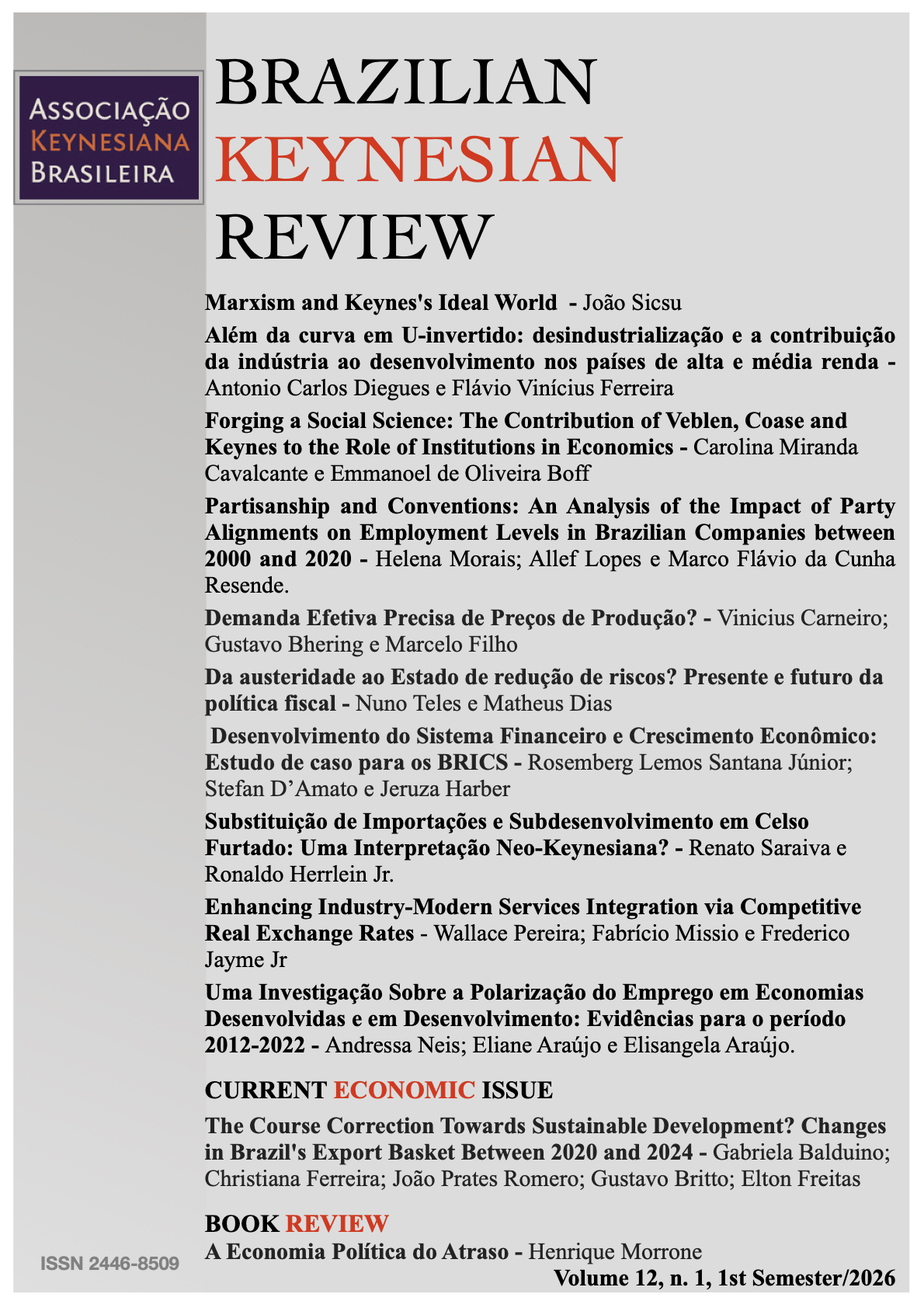
Financial System Development and Economic Growth:
A Case Study for the BRICS
DOI:
https://doi.org/10.33834/bkr.v12i1.335Keywords:
financial system, Economic Growth, BRICSAbstract
This study empirically examines the relationship between financial system development and economic growth, focusing on BRICS countries (Brazil, Russia, India, China, and South Africa) from 2000 to 2020. A dynamic panel data model was estimated using the System GMM method, with private sector credit (DCPS) and the broad monetary aggregate (M3) as proxies for financial development, along with control variables such as gross fixed capital formation, inflation, and the real effective exchange rate. Results indicate that monetary expansion (M3) had positive and significant effects on economic growth in BRICS, whereas private credit displayed a negative and marginal impact. Furthermore, maintaining a competitive exchange rate proved essential for sustained growth. The findings suggest that the combination of monetary expansion, productive investment, and exchange rate stability is key to supporting long-term economic growth in these economies, reinforcing the post-Keynesian view of the integration between money, credit, and development.
Downloads
References
Acaravci, A. (2009). Financial development and economic growth: Literature survey and empirical evidence from Sub-Saharan African countries. South African Journal of Economic and Management Sciences, 12(1), 11–27.
Adusei, M. (2013). Financial development and economic growth: Evidence from Ghana. International Journal of Business and Finance Research, 7(5), 61–76.
Aguiar, Á. (2002). Sistema financeiro e desenvolvimento econômico. Universidade de Coimbra.
Allen, F., & Gale, D. (2001). Comparative financial systems: A survey (Wharton Financial Institutions Center Working Paper).
Amaral, J. F., & Oreiro, J. L. (2008). A política monetária e fiscal numa economia com moeda endógena e salários indexados. Ensaios FEE, 29(2), 269–297.
Araújo, R. A. C. (2016). Sistema financeiro e crescimento económico nos países da OCDE: 1980–2011 (Tese de doutorado, Universidade de Coimbra).
Arellano, M., & Bond, S. (1991). Some tests of specification for panel data: Monte Carlo evidence and an application to employment equations. Review of Economic Studies, 58(2), 277–297. DOI: 10.2307/2297968
Arellano, M., & Bover, O. (1995). Another look at the instrumental variable estimation of error-components models. Journal of Econometrics, 68(1), 29–51. DOI: 10.1016/0304-4076(94)01642-D
Bank for International Settlements. (2020). Annual economic report.
Bara, A., Mugano, G., & Le Roux, P. (2016). Financial development and economic growth in Zimbabwe. African Development Review, 28(4), 468–481.
Barradas, R. (2015). Evolution of the financial sector: Three different stages—Repression, development and financialisation (DINÂMIA'CET-IUL Working Paper No. 08).
Beck, T., Levine, R., & Loayza, N. (2000). Finance and the sources of growth. Journal of Financial Economics, 58(1–2), 261–300. DOI: 10.1016/S0304-405X(00)00072-6
Blanchard, O. (2004). Inflation targeting in transition economies: Experience and prospects. In B. S. Bernanke & M. Woodford (Eds.), Inflation targeting (pp. 12–54). Princeton University Press.
Blundell, R., & Bond, S. (1998). Initial conditions and moment restrictions in dynamic panel data models. Journal of Econometrics, 87(1), 115–143. DOI: 10.1016/S0304-4076(98)00009-8
Borio, C., & Lowe, P. (2002). Asset prices, financial and monetary stability: Exploring the nexus (BIS Working Paper No. 114).
Boston Consulting Group. (2016). Global payments report.
Calderón, C., & Liu, L. (2003). The direction of causality between financial development and economic growth. Journal of Development Economics, 72(1), 321–334. DOI: 10.1016/S0304-3878(03)00079-8
Cecchetti, S., & Kharroubi, E. (2012). Reassessing the impact of finance on growth (BIS Working Paper No. 381).
Cletus, O., Johannes, A., & Njang, J. (2011). Financial development and economic growth in Nigeria. Journal of Economics and Sustainable Development, 2(4), 35–45.
Darrat, A. F. (2002). On the long-run relationship between financial development and economic growth. Applied Economics Letters, 9(4), 223–226. DOI: 10.1080/13504850110061988
Darvas, Z. (2022). Timely measurement of real effective exchange rates (Bruegel Working Paper).
Deidda, L., & Fattouh, B. (2002). Non-linearity between finance and growth. Economics Letters, 74(3), 339–345. DOI: 10.1016/S0165-1765(01)00571-7
Durusu-Ciftci, D., Ispir, M. S., & Yetkiner, H. (2017). Financial development and economic growth: Some theory and more evidence. Journal of Policy Modeling, 39(2), 290–306. DOI: 10.1016/j.jpolmod.2016.08.001
Federici, D., & Caprioli, F. (2009). Financial development and growth. Economic Notes, 38(1–2), 69–91.
Frenkel, R., & Rapetti, M. (2009). A developing country view of the current global crisis. Cambridge Journal of Economics, 33(4), 685–702. DOI: 10.1093/cje/bep044
Gabriel, V. (2016). Econometria aplicada a dados em painel dinâmico. Revista Brasileira de Economia, 70(2), 145–167.
Goldsmith, R. W. (1969). Financial structure and development. Yale University Press.
Greenwood, J., & Jovanovic, B. (1990). Financial development, growth, and the distribution of income. Journal of Political Economy, 98(5), 1076–1107. DOI: 10.1086/261720
De Gregorio, J., & Guidotti, P. E. (1995). Financial development and economic growth. World Development, 23(3), 433–448. DOI: 10.1016/0305-750X(94)00132-I
Gurley, J. G., & Shaw, E. S. (1960). Money in a theory of finance. Brookings Institution.
Huang, Y., & Xu, L. (1999). Financial institutions and economic growth. Journal of Development Economics, 58(1), 85–112.
Ibrahim, M., & Alagidede, P. (2018). Nonlinearities in financial development–growth nexus. Research in International Business and Finance, 46, 95–104. DOI: 10.1016/j.ribaf.2017.09.002
Inoue, T., & Hamori, S. (2016). Financial access and economic growth. Economics Bulletin, 36(3), 1–15.
Jun, S. (2012). Financial development and output growth: A panel study for Asian countries. Journal of East Asian Economic Integration, 16(1), 97–115.
Keynes, J. M. (1937). Alternative theories of the rate of interest. The Economic Journal, 47(186), 241–252.
Khan, M. S., & Senhadji, A. S. (2000). Financial development and economic growth: An overview (IMF Working Paper No. 00/209).
King, R. G., & Levine, R. (1993). Finance and growth: Schumpeter might be right. Quarterly Journal of Economics, 108(3), 717–737. DOI: 10.2307/2118406
Law, S. H., & Singh, N. (2014). Does too much finance harm economic growth? Journal of Banking & Finance, 41, 36–44. DOI: 10.1016/j.jbankfin.2013.12.020
Levine, R. (1997). Financial development and economic growth: Views and agenda. Journal of Economic Literature, 35(2), 688–726.
Levine, R. (2004). Finance and growth: Theory and evidence (NBER Working Paper No. 10766). DOI: 10.3386/w10766
Levine, R. (2005). Finance and growth. In P. Aghion & S. N. Durlauf (Eds.), Handbook of economic growth (Vol. 1A, pp. 865–934). Elsevier.
Levine, R., & Zervos, S. (1998). Stock markets, banks, and economic growth. American Economic Review, 88(3), 537–558.
Matos, O. C. de. (2002). Desenvolvimento do sistema financeiro e crescimento econômico no Brasil: Evidências de causalidade (Working Paper Series No. 49). Banco Central do Brasil.
McKinsey & Company. (2023). Global banking annual review 2023.
Mendes, N. C. (2018). Os efeitos do sistema financeiro no crescimento económico em Portugal (Tese de doutorado, Universidade do Porto).
Moosa, I. A. (2017). Finance and growth: A critical assessment. Journal of Economic Studies, 44(2), 281–295. DOI: 10.1108/JES-04-2015-0072
Ngongang, E. (2015). Financial development and economic growth in Sub-Saharan Africa: A dynamic panel analysis. African Review of Economics and Finance, 7(1), 1–20.
Oluitan, O. O. (2012). Financial development and economic growth in Nigeria: Evidence from time series analysis. International Journal of Economics and Finance, 4(2), 154–161. DOI: 10.5539/ijef.v4n2p154
Paiva, F. (2016). Inovações financeiras e crescimento econômico: Uma análise crítica (Dissertação de mestrado, Universidade Federal de Minas Gerais).
Rajan, R. G., & Zingales, L. (1998). Financial dependence and growth. American Economic Review, 88(3), 559–586.
Rioja, F., & Valev, N. (2004). Finance and growth at different stages of economic development. Economic Inquiry, 42(1), 127–140. DOI: 10.1093/ei/cbh049
Romer, P. M. (1990). Endogenous technological change. Journal of Political Economy, 98(5, Pt. 2), S71–S102. DOI: 10.1086/261725
Roodman, D. (2009). How to do xtabond2: An introduction to difference and system GMM in Stata. The Stata Journal, 9(1), 86–136. DOI: 10.1177/1536867X0900900106
Saci, K., Giorgioni, G., & Holden, K. (2009). Does financial development affect growth? Applied Economics, 41(13), 1701–1707. DOI: 10.1080/00036840701335538
Sahay, R., Čihák, M., N’Diaye, P., Barajas, A., Mitra, S., Kyobe, A., Mooi, Y. N., & Yousefi, S. R. (2015). Rethinking financial deepening: Stability and growth in emerging markets (IMF Staff Discussion Note SDN/15/08). International Monetary Fund.
Schumpeter, J. A. (1934). The theory of economic development. Harvard University Press. (Obra original publicada em 1912)
Sicsú, J., & Cardim de Carvalho, F. J. (2005). Moeda, crédito e desenvolvimento. Economia e Sociedade, 14(1), 101–124.
Kuznets, S. (1955). Economic growth and income inequality. American Economic Review, 45(1), 1–28.
Downloads
Published
How to Cite
Issue
Section
License
Copyright (c) 2026 Rosemberg Lemos Santana Júnior , Jeruza Haber, D'Amato

This work is licensed under a Creative Commons Attribution 4.0 International License.
- Authors keep copyrights and concede to the Journal the right to the first publication, with the paper simultaneously licenced under the Creative Commons Attribution 4.0 International License which allows recognised author and journal work sharing.
- Authors are authorized to assume additional contracts separately, for non-exclusive versions of the paper published in this journal (e.g.: publish in an instituional repository or as a book chapter) with the recogntion of authorship and initial publication in this journal.
- Authors are allowed (and are estimulated) to publish and distribute their work online (e.g.: in institutional repositories or at their personal websites) at any point before or during the editorial process, once this may generate productive alterations on the paper, as well as increse the factor of impact and quotation of the published paper (please, see Free Access Effect)