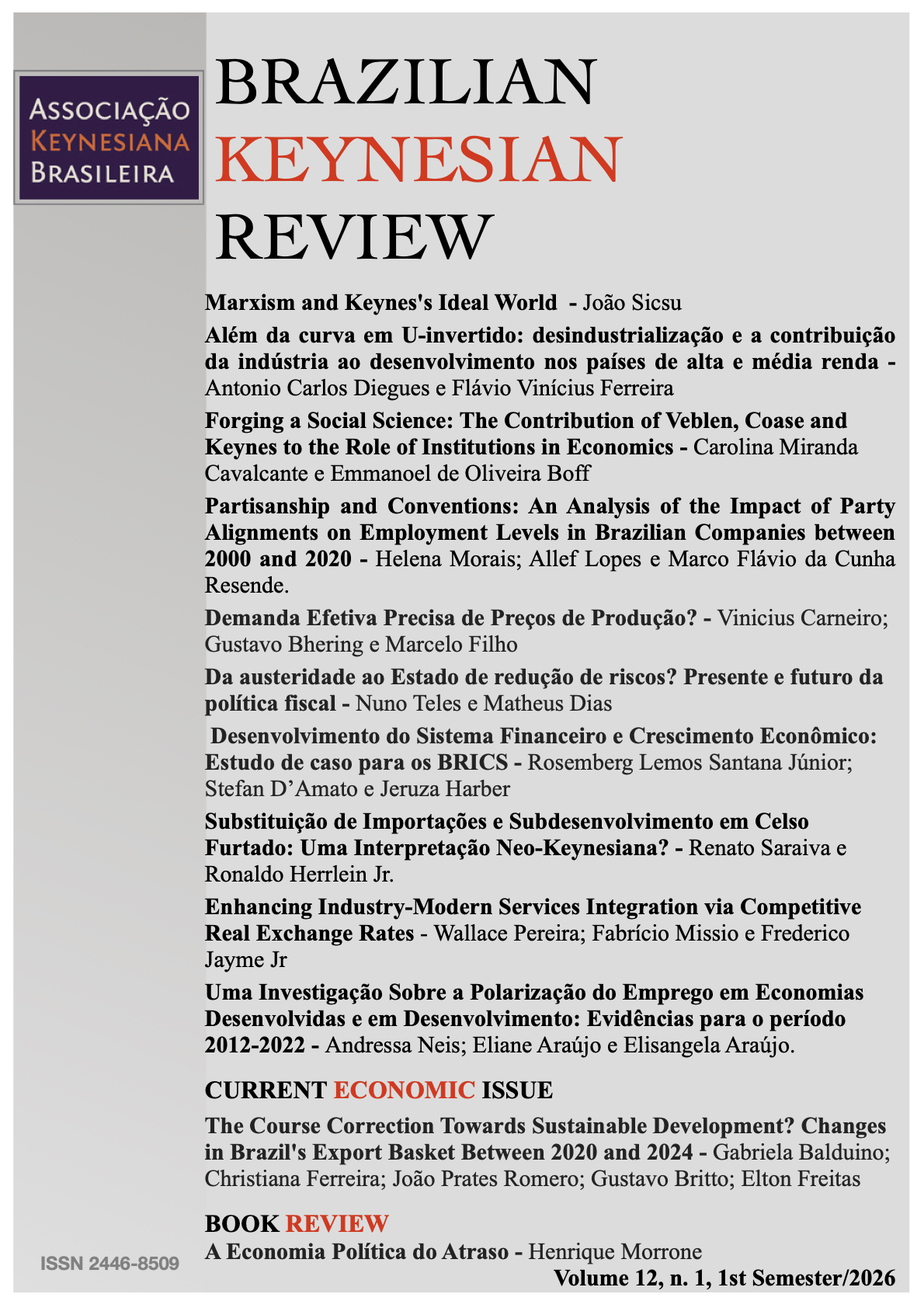
Desenvolvimento do Sistema Financeiro e Crescimento Econômico:
Estudo de caso para os BRICS
DOI:
https://doi.org/10.33834/bkr.v12i1.335Palavras-chave:
sistema financeiro, crescimento economico, BRICSResumo
O presente estudo analisa empiricamente a relação entre desenvolvimento do sistema financeiro e crescimento econômico, com foco nos países do BRICS (Brasil, Rússia, Índia, China e África do Sul) no período de 2000 a 2020. Para isso, estimou-se um modelo dinâmico de dados em painel pelo método System GMM, utilizando como proxies do sistema financeiro o crédito doméstico ao setor privado (DCPS) e o agregado monetário amplo (M3), além de variáveis de controle como formação bruta de capital fixo, inflação e taxa de câmbio real efetiva. Os resultados indicam que a expansão monetária (M3) exerceu efeitos positivos e significativos sobre o crescimento econômico nos BRICS, enquanto o crédito privado apresentou impacto negativo e marginal. Ademais, a taxa de câmbio competitiva mostrou-se determinante para o crescimento sustentado. Conclui-se que a integração entre política monetária, investimento produtivo e estabilidade cambial é essencial para sustentar o crescimento econômico de longo prazo nesses países.
Downloads
Referências
Acaravci, A. (2009). Financial development and economic growth: Literature survey and empirical evidence from Sub-Saharan African countries. South African Journal of Economic and Management Sciences, 12(1), 11–27.
Adusei, M. (2013). Financial development and economic growth: Evidence from Ghana. International Journal of Business and Finance Research, 7(5), 61–76.
Aguiar, Á. (2002). Sistema financeiro e desenvolvimento econômico. Universidade de Coimbra.
Allen, F., & Gale, D. (2001). Comparative financial systems: A survey (Wharton Financial Institutions Center Working Paper).
Amaral, J. F., & Oreiro, J. L. (2008). A política monetária e fiscal numa economia com moeda endógena e salários indexados. Ensaios FEE, 29(2), 269–297.
Araújo, R. A. C. (2016). Sistema financeiro e crescimento económico nos países da OCDE: 1980–2011 (Tese de doutorado, Universidade de Coimbra).
Arellano, M., & Bond, S. (1991). Some tests of specification for panel data: Monte Carlo evidence and an application to employment equations. Review of Economic Studies, 58(2), 277–297. DOI: 10.2307/2297968
Arellano, M., & Bover, O. (1995). Another look at the instrumental variable estimation of error-components models. Journal of Econometrics, 68(1), 29–51. DOI: 10.1016/0304-4076(94)01642-D
Bank for International Settlements. (2020). Annual economic report.
Bara, A., Mugano, G., & Le Roux, P. (2016). Financial development and economic growth in Zimbabwe. African Development Review, 28(4), 468–481.
Barradas, R. (2015). Evolution of the financial sector: Three different stages—Repression, development and financialisation (DINÂMIA'CET-IUL Working Paper No. 08).
Beck, T., Levine, R., & Loayza, N. (2000). Finance and the sources of growth. Journal of Financial Economics, 58(1–2), 261–300. DOI: 10.1016/S0304-405X(00)00072-6
Blanchard, O. (2004). Inflation targeting in transition economies: Experience and prospects. In B. S. Bernanke & M. Woodford (Eds.), Inflation targeting (pp. 12–54). Princeton University Press.
Blundell, R., & Bond, S. (1998). Initial conditions and moment restrictions in dynamic panel data models. Journal of Econometrics, 87(1), 115–143. DOI: 10.1016/S0304-4076(98)00009-8
Borio, C., & Lowe, P. (2002). Asset prices, financial and monetary stability: Exploring the nexus (BIS Working Paper No. 114).
Boston Consulting Group. (2016). Global payments report.
Calderón, C., & Liu, L. (2003). The direction of causality between financial development and economic growth. Journal of Development Economics, 72(1), 321–334. DOI: 10.1016/S0304-3878(03)00079-8
Cecchetti, S., & Kharroubi, E. (2012). Reassessing the impact of finance on growth (BIS Working Paper No. 381).
Cletus, O., Johannes, A., & Njang, J. (2011). Financial development and economic growth in Nigeria. Journal of Economics and Sustainable Development, 2(4), 35–45.
Darrat, A. F. (2002). On the long-run relationship between financial development and economic growth. Applied Economics Letters, 9(4), 223–226. DOI: 10.1080/13504850110061988
Darvas, Z. (2022). Timely measurement of real effective exchange rates (Bruegel Working Paper).
Deidda, L., & Fattouh, B. (2002). Non-linearity between finance and growth. Economics Letters, 74(3), 339–345. DOI: 10.1016/S0165-1765(01)00571-7
Durusu-Ciftci, D., Ispir, M. S., & Yetkiner, H. (2017). Financial development and economic growth: Some theory and more evidence. Journal of Policy Modeling, 39(2), 290–306. DOI: 10.1016/j.jpolmod.2016.08.001
Federici, D., & Caprioli, F. (2009). Financial development and growth. Economic Notes, 38(1–2), 69–91.
Frenkel, R., & Rapetti, M. (2009). A developing country view of the current global crisis. Cambridge Journal of Economics, 33(4), 685–702. DOI: 10.1093/cje/bep044
Gabriel, V. (2016). Econometria aplicada a dados em painel dinâmico. Revista Brasileira de Economia, 70(2), 145–167.
Goldsmith, R. W. (1969). Financial structure and development. Yale University Press.
Greenwood, J., & Jovanovic, B. (1990). Financial development, growth, and the distribution of income. Journal of Political Economy, 98(5), 1076–1107. DOI: 10.1086/261720
De Gregorio, J., & Guidotti, P. E. (1995). Financial development and economic growth. World Development, 23(3), 433–448. DOI: 10.1016/0305-750X(94)00132-I
Gurley, J. G., & Shaw, E. S. (1960). Money in a theory of finance. Brookings Institution.
Huang, Y., & Xu, L. (1999). Financial institutions and economic growth. Journal of Development Economics, 58(1), 85–112.
Ibrahim, M., & Alagidede, P. (2018). Nonlinearities in financial development–growth nexus. Research in International Business and Finance, 46, 95–104. DOI: 10.1016/j.ribaf.2017.09.002
Inoue, T., & Hamori, S. (2016). Financial access and economic growth. Economics Bulletin, 36(3), 1–15.
Jun, S. (2012). Financial development and output growth: A panel study for Asian countries. Journal of East Asian Economic Integration, 16(1), 97–115.
Keynes, J. M. (1937). Alternative theories of the rate of interest. The Economic Journal, 47(186), 241–252.
Khan, M. S., & Senhadji, A. S. (2000). Financial development and economic growth: An overview (IMF Working Paper No. 00/209).
King, R. G., & Levine, R. (1993). Finance and growth: Schumpeter might be right. Quarterly Journal of Economics, 108(3), 717–737. DOI: 10.2307/2118406
Law, S. H., & Singh, N. (2014). Does too much finance harm economic growth? Journal of Banking & Finance, 41, 36–44. DOI: 10.1016/j.jbankfin.2013.12.020
Levine, R. (1997). Financial development and economic growth: Views and agenda. Journal of Economic Literature, 35(2), 688–726.
Levine, R. (2004). Finance and growth: Theory and evidence (NBER Working Paper No. 10766). DOI: 10.3386/w10766
Levine, R. (2005). Finance and growth. In P. Aghion & S. N. Durlauf (Eds.), Handbook of economic growth (Vol. 1A, pp. 865–934). Elsevier.
Levine, R., & Zervos, S. (1998). Stock markets, banks, and economic growth. American Economic Review, 88(3), 537–558.
Matos, O. C. de. (2002). Desenvolvimento do sistema financeiro e crescimento econômico no Brasil: Evidências de causalidade (Working Paper Series No. 49). Banco Central do Brasil.
McKinsey & Company. (2023). Global banking annual review 2023.
Mendes, N. C. (2018). Os efeitos do sistema financeiro no crescimento económico em Portugal (Tese de doutorado, Universidade do Porto).
Moosa, I. A. (2017). Finance and growth: A critical assessment. Journal of Economic Studies, 44(2), 281–295. DOI: 10.1108/JES-04-2015-0072
Ngongang, E. (2015). Financial development and economic growth in Sub-Saharan Africa: A dynamic panel analysis. African Review of Economics and Finance, 7(1), 1–20.
Oluitan, O. O. (2012). Financial development and economic growth in Nigeria: Evidence from time series analysis. International Journal of Economics and Finance, 4(2), 154–161. DOI: 10.5539/ijef.v4n2p154
Paiva, F. (2016). Inovações financeiras e crescimento econômico: Uma análise crítica (Dissertação de mestrado, Universidade Federal de Minas Gerais).
Rajan, R. G., & Zingales, L. (1998). Financial dependence and growth. American Economic Review, 88(3), 559–586.
Rioja, F., & Valev, N. (2004). Finance and growth at different stages of economic development. Economic Inquiry, 42(1), 127–140. DOI: 10.1093/ei/cbh049
Romer, P. M. (1990). Endogenous technological change. Journal of Political Economy, 98(5, Pt. 2), S71–S102. DOI: 10.1086/261725
Roodman, D. (2009). How to do xtabond2: An introduction to difference and system GMM in Stata. The Stata Journal, 9(1), 86–136. DOI: 10.1177/1536867X0900900106
Saci, K., Giorgioni, G., & Holden, K. (2009). Does financial development affect growth? Applied Economics, 41(13), 1701–1707. DOI: 10.1080/00036840701335538
Sahay, R., Čihák, M., N’Diaye, P., Barajas, A., Mitra, S., Kyobe, A., Mooi, Y. N., & Yousefi, S. R. (2015). Rethinking financial deepening: Stability and growth in emerging markets (IMF Staff Discussion Note SDN/15/08). International Monetary Fund.
Schumpeter, J. A. (1934). The theory of economic development. Harvard University Press. (Obra original publicada em 1912)
Sicsú, J., & Cardim de Carvalho, F. J. (2005). Moeda, crédito e desenvolvimento. Economia e Sociedade, 14(1), 101–124.
Kuznets, S. (1955). Economic growth and income inequality. American Economic Review, 45(1), 1–28.
Downloads
Publicado
Como Citar
Edição
Seção
Licença
Copyright (c) 2026 Rosemberg Lemos Santana Júnior , Jeruza Haber, D'Amato

Este trabalho está licenciado sob uma licença Creative Commons Attribution 4.0 International License.
- Autores mantém os direitos autorais e concedem à revista o direito de primeira publicação, com o trabalho simultaneamente licenciado sob a Licença Creative Commons Attribution que permite o compartilhamento do trabalho com reconhecimento da autoria e publicação inicial nesta revista.
- Autores têm autorização para assumir contratos adicionais separadamente, para distribuição não-exclusiva da versão do trabalho publicada nesta revista (ex.: publicar em repositório institucional ou como capítulo de livro), com reconhecimento de autoria e publicação inicial nesta revista.
- Autores têm permissão e são estimulados a publicar e distribuir seu trabalho online (ex.: em repositórios institucionais ou na sua página pessoal) a qualquer ponto antes ou durante o processo editorial, já que isso pode gerar alterações produtivas, bem como aumentar o impacto e a citação do trabalho publicado (Veja O Efeito do Acesso Livre).