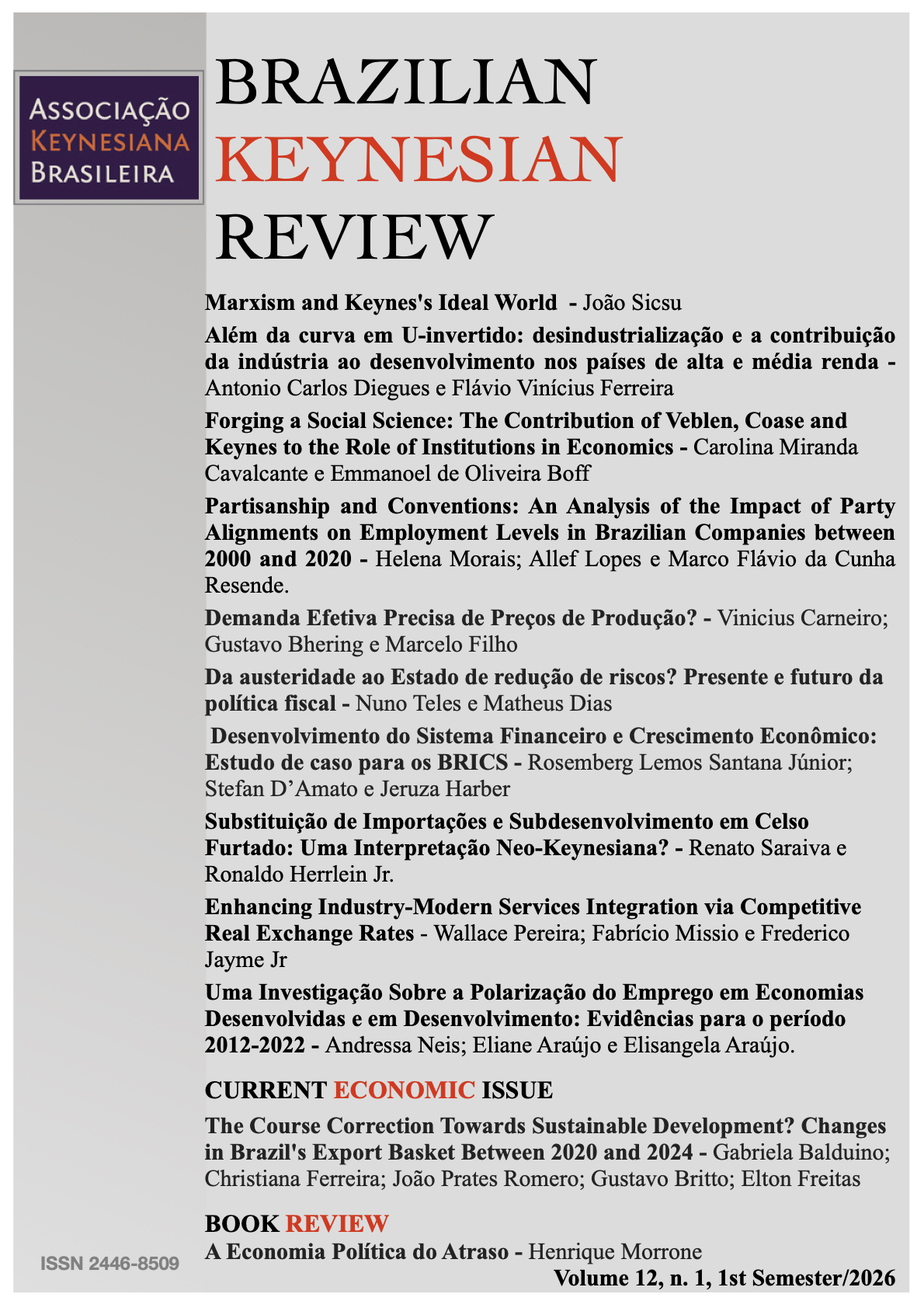
Import Substitution and Underdevelopment in Celso Furtado:
A “Neo-Keynesian” Interpretation?
DOI:
https://doi.org/10.33834/bkr.v12i1.396Keywords:
Kaldor, Neo-Keynesianism, Underdevelopment, Celso FurtadoAbstract
The main objective of this paper is to investigate the impact of the formulation of macro-dynamic models from a Neo-Keynesian perspective on Celso Furtado’s analysis of the processes of import substitution and underdevelopment during the 1960s and 1970s. Given the influence of Neo-Keynesian growth models, particularly those developed by Kaldor, during Furtado’s stay at King’s College, Cambridge, the paper highlights both the similarities and the differences between these models and Furtado’s own view of growth in underdeveloped economies. In doing so, it seeks to provide a better understanding of Furtado’s analysis of the import-substitution model and of his predictions for peripheral economies, including the prospect of stagnation in per capita output resulting from the exhaustion of that model.
Downloads
References
Carvalho, F. J. C. de. (2008). Keynes e o Brasil. Economia e Sociedade, 17(Número Especial), 569–574.
Coutinho, M. (2015). Subdesenvolvimento e estagnação na América Latina, de Celso Fur-tado. Revista de Economia Contemporânea, 19(3), 448–474.
Domar, E. D. (1946). Capital expansion, rate of growth and employment. Econometrica, 14(2), 137–147. DOI:10.2307/1905364
Furtado, C. (1962). A pré-revolução brasileira. Fundo de Cultura.
Furtado, C. (1978). A hegemonia dos Estados Unidos e o subdesenvolvimento da América Latina. Ci-vilização Brasileira. (Obra original publicada em 1973)
Furtado, C. (1964). Dialética do desenvolvimento. Fundo de Cultura.
Furtado, C. (1966). Subdesenvolvimento e estagnação na América Latina. Civilização Brasileira.
Furtado, C. (1967). Teoria e política do desenvolvimento econômico. Companhia Editora Nacional.
Furtado, C. (1971). Teoria e política do desenvolvimento econômico (4ª ed.). Companhia Editora Nacional.
Furtado, C. (1974). O mito do desenvolvimento econômico. Círculo do Livro.
Furtado, C. (1975). Teoria e política do desenvolvimento econômico (5ª ed.). Companhia Editora Nacional.
Furtado, C. (1981). Pequena introdução ao desenvolvimento (2ª ed.). Companhia Editora Nacional.
Furtado, C. (1983). Teoria e política do desenvolvimento econômico. Abril Cultural.
Furtado, C. (1985). A fantasia organizada. Paz e Terra.
Furtado, C. (2005). Formação econômica do Brasil. Editora Nacional.
Furtado, C., & Maneschi, A. (1968). Um modelo simulado de desenvolvimento e estagna-ção na América Latina. Revista Brasileira de Economia, 22(2), 7–31.
Harrod, R. F. (1948). Towards a dynamic economics. Macmillan.
Heller, C., & D’Arbo, R. C. (2012). Evolução da abordagem analítica da teoria do desen-volvimento de Celso Furtado. Cadernos do Desenvolvimento, 7(10), 17–40.
Kaldor, N. (1957). A model of economic growth. The Economic Journal, 67(268), 591–624. DOI:10.2307/2227704
Kaldor, N., & Mirrlees, J. A. (1962). A new model of economic growth. The Review of Eco-nomic Studies, 29(3), 174–192. DOI: 10.2307/2295949
Keynes, J. M. (1996). A teoria geral do emprego, do juro e da moeda. Nova Cultural. (Obra origi-nal publicada em 1936)
Pereira, H. C. I., & Gonçalves, F. de O. (2015). O crescimento econômico em Nicholas Kaldor e o subdesenvolvimento em Celso Furtado: Progresso técnico, distribuição de renda e dualismo estrutural. In Anais do XI Congresso Brasileiro de História Econômica e 12ª Conferência Internacional de História de Empresas. Associação Brasileira de Pesqui-sadores em História Econômica.
Ricupero, B. (2005). Celso Furtado e o pensamento social brasileiro. Estudos Avançados, 19(53), 371–377. DOI: 10.1590/S0103-40142005000100023
Rodríguez, O. (2009). O estruturalismo latino-americano. Civilização Brasileira.
Solow, R. M. (1957). Technical change and the aggregate production function. The Review of Economics and Statistics, 39(3), 312–320. DOI:10.2307/1926047
Solow, R. M., Tobin, J., Von Weizsäcker, C. C., & Yaari, M. E. (1966). Neoclassical growth with fixed factor proportions. The Review of Economic Studies, 33(2), 79–115. DOI:10.2307/2296058
Downloads
Published
How to Cite
Issue
Section
License
Copyright (c) 2026 Renato Saraiva, Ronaldo Herrlein Jr.

This work is licensed under a Creative Commons Attribution 4.0 International License.
- Authors keep copyrights and concede to the Journal the right to the first publication, with the paper simultaneously licenced under the Creative Commons Attribution 4.0 International License which allows recognised author and journal work sharing.
- Authors are authorized to assume additional contracts separately, for non-exclusive versions of the paper published in this journal (e.g.: publish in an instituional repository or as a book chapter) with the recogntion of authorship and initial publication in this journal.
- Authors are allowed (and are estimulated) to publish and distribute their work online (e.g.: in institutional repositories or at their personal websites) at any point before or during the editorial process, once this may generate productive alterations on the paper, as well as increse the factor of impact and quotation of the published paper (please, see Free Access Effect)